
‘Nomadic Home’, c. 2002. Wood, felt, textiles, mixed media, video installation.
Sergey Maslov
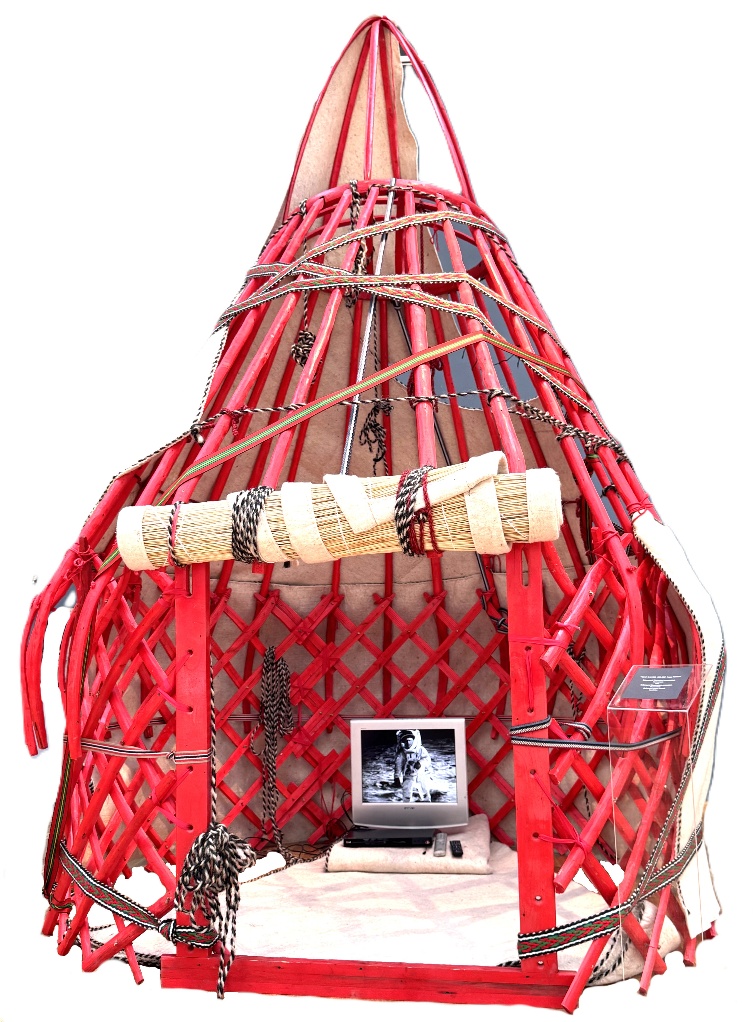
In this installation, the traditional structure of the Kazakh yurt serves as the basis for a contemporary artistic statement, in which wood functions no longer merely as a structural material, but as a carrier of cultural memory and symbolic form. The frame, formed by the kerege and uyk, retains the recognisable structure of a nomadic dwelling, yet is deliberately removed from its familiar domestic context.The artistic tension of the composition is built on the deconstruction of the traditional image. The bright red colour of the wooden elements disrupts the natural perception of the material and transports the structure into a realm of convention and artistic gesture. The disruption of the covering’s integrity, the introduction of textile fragments and rope ties create a sense of fragmentation and transformation, as if the object were in a state of transition between preservation and decay.Through the incorporation of media, the yurt ceases to be perceived as a static object and transforms into a dynamic environment of interaction between the visual image, the space and the viewer. As a result, the work transcends the boundaries of decorative and applied art and enters the realm of contemporary art practices.The contrast between the archaic structure and contemporary artistic means creates a complex dialogue between different temporal layers. The wooden frame retains an associative link with nomadic culture and a traditional worldview, whilst the intervention of contemporary media and the altered colour scheme shift the object into the realm of critical artistic interpretation.Felt and textile elements reinforce the material connection with nomadic culture; however, in this instance, they function not as a reconstruction of an ethnographic environment, but as elements of an artistic metaphor. The installation unfolds as a reflection on the transformation of cultural identity, the loss of stable forms of traditional life, and an attempt to reinterpret them in the context of the modern world.