
Mausoleum painting
Photograph and drawing by A. Ordabaev
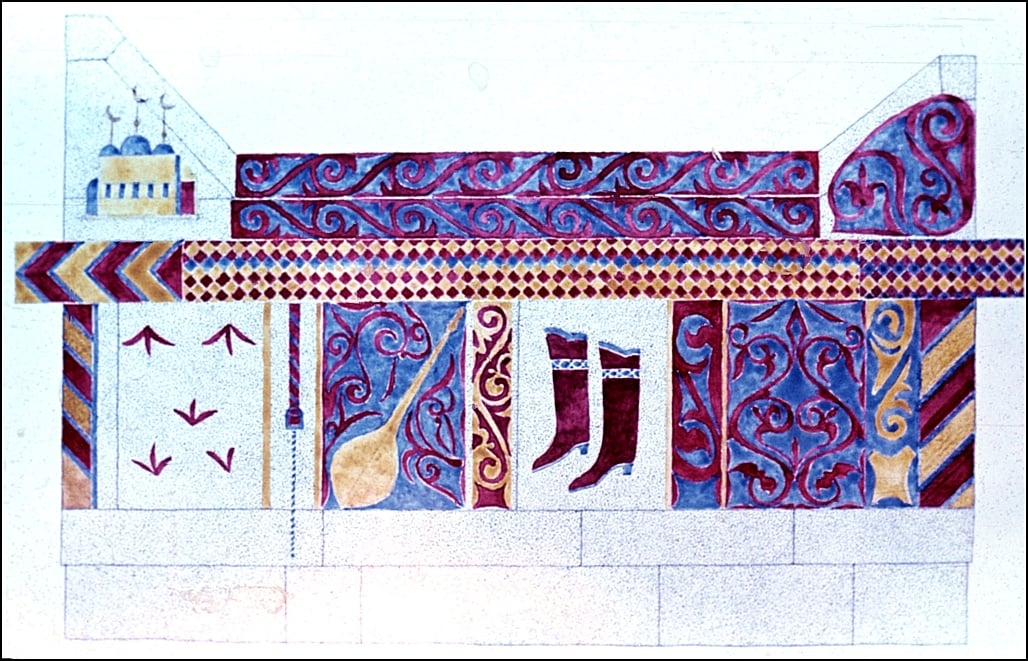
Analysing the murals of the mausoleums of Western Kazakhstan, K. Ibraeva notes that the ornamental compositions, executed in the form of broad friezes and encircling the room along its perimeter, structurally correspond to the arrangement of the kyzyl-baskur. Above this, an akbaskur (ceremonial band) was sometimes placed, distinguished by a freer composition featuring motifs of curling plant stems.Ornaments in the form of curling stems, their interlacing and palmettes (zhaukyzyn), which are widespread in Kazakh art, convey the ideas of eternal renewal, rebirth, unity and continuous development. They are represented in a multitude of variations — from tree-like compositions with a vertical axis of symmetry to mesh-like and centric structures. Tree-like motifs are, likely, associated with conceptions of the World Tree, connecting the heavenly, earthly and subterranean levels of the cosmos.Amidst the rich repertoire of ornamentation, one also finds stylised, two-dimensional depictions of objects: samovars with tea sets, footwear, musical instruments (the dombra), whips, weapons, jewellery, and so on. These elements reflect the belief that objects possess a spirit and hold significance in the afterlife. At the same time, each object acts as a symbol: footwear symbolises the path, a musical instrument symbolises the sound that connects worlds, and so on.