
Kapsyrma
North Kazakhstan. Silver, carnelian, coral, glass, smalt, engraving, filigree. A. Kasteev National Museum of Arts of the Republic of Kazakhstan
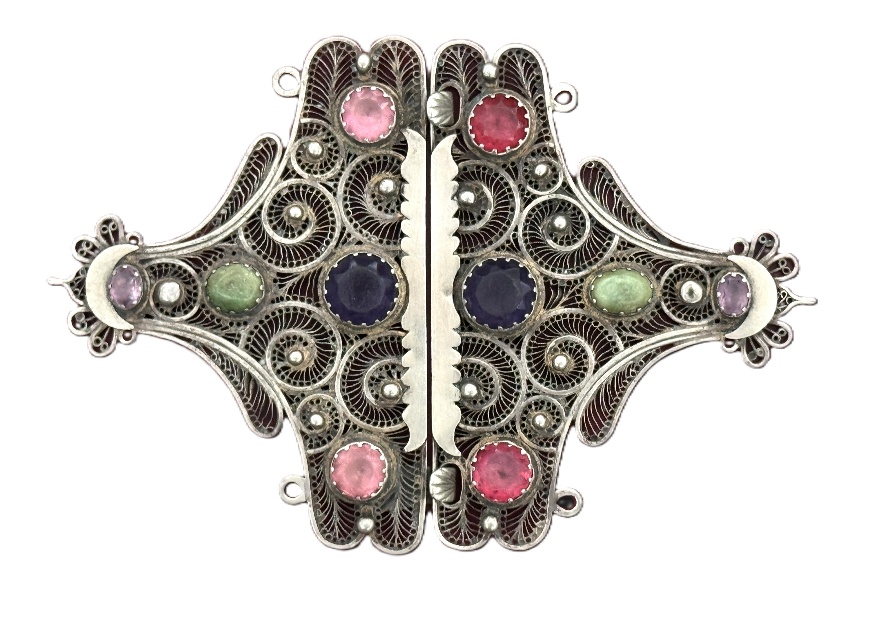
Kapsyrma (clasp). The item is a complex double clasp with an elaborate decorative composition, consisting of two symmetrical halves connected by a central hinge mechanism. The design is intended to fasten items of clothing, with the main artistic focus centred on the ornamental decoration of the surface.The composition has a cross-shaped, flaring form with pronounced axial symmetry. The central zone is accentuated by a vertical connecting element, from which a system of filigree curls radiates outwards. The ornament is based on spiral motifs, forming a dense openwork structure characteristic of the skani technique.The decorative field includes coloured inlays — carnelian, coral, glass and smalt — set in mounts and evenly distributed across the surface of the piece. Their placement follows the principle of rhythmic alternation and symmetry, which reinforces the composition’s unity. The side projections are finished with crescent-shaped elements, which may indicate a symbolic meaning linked to traditional beliefs and the protective function of the ornament.Technologically, the piece is executed using a combined technique: filigree elements are soldered from fine wire to form an ornamental pattern, after which they are enhanced with engraving and stone settings. A hinge mechanism ensures the mobility of the flaps and secure fastening.This clasp demonstrates a high level of jewellery craftsmanship, in which the filigree technique plays a leading role, allowing for the achievement of complex plastic and graphic expressiveness. The piece reflects the developed tradition of 20th-century North Kazakh jewellery art, characterised by decorative richness and the symbolic multi-layered nature of form.