
Bracelet. Silver; casting, forging, engraving. Source: open sources, attribution to be confirmed.
Amangeldy Mukazhanov
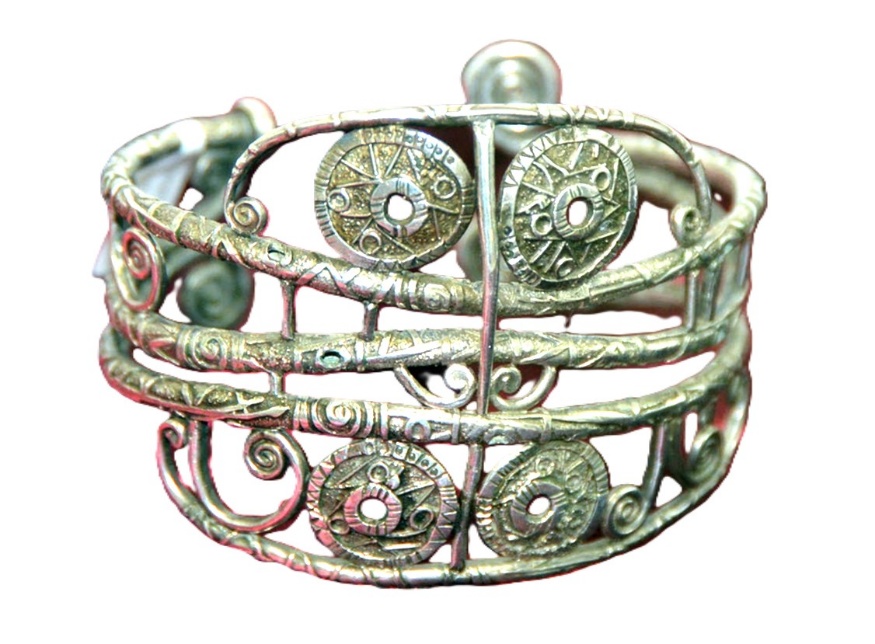
The frame bracelet is crafted in the form of an open cylindrical structure with a clearly defined spatial arrangement. A system of parallel horizontal elements, connected by vertical crossbars, forms an openwork volume, thanks to which the piece retains a visual lightness whilst maintaining structural stability.The basis of the artistic design lies in the rhythmic repetition of ornamental modules, evenly distributed across the surface of the bracelet. Central to the design are circular discs featuring geometric decoration, including radial and linear motifs, as well as spiral scrolls integrated into the overall composition. The repeating ornament creates a sense of continuous movement and organises the piece’s space according to the principle of cyclicality.The bracelet’s figurative structure is linked to traditional notions of order and the interconnectedness of the world. The circular elements are associated with solar symbolism and the cosmic cycle, whilst the spiral forms refer to ideas of development, movement and vital energy. The open framework construction enhances the sense of spatiality and echoes the principles of nomadic architectural environments.The distinctive feature of the work lies in the reinterpretation of traditional ornamentation through a structural and almost architectural approach. The focus is not only on the decorative surface, but also on the spatial organisation of the form. As a result, the bracelet is perceived as a three-dimensional artistic object, where structure and ornamentation form a unified plastic system.