
Decorative chest of drawers, 21st century. Wood, carving.
Alibek Nishanbaev
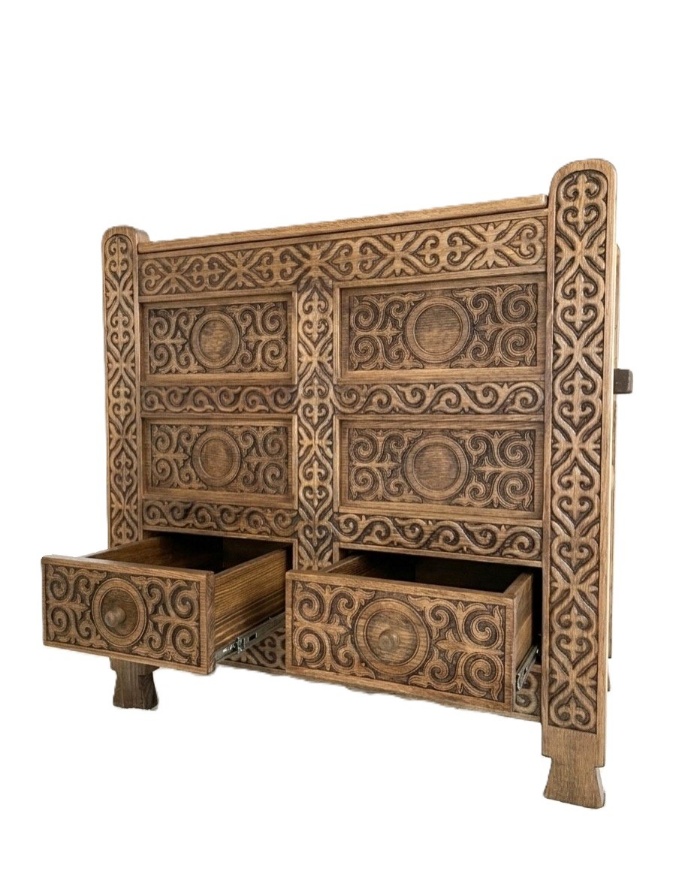
The artistic concept behind this piece is based on a reinterpretation of traditional Kazakh storage items—the sandyq and asadal—through the language of contemporary decorative furniture. While preserving the archetypal structure of the traditional household object, the artist adapts it to the contemporary interior space, introducing a system of pull-out drawers and a more complex façade design.The composition is built on the principle of strict symmetry and a clear rhythmic division of the plane. The geometrically precise design, based on the interplay of rectangular sections, horizontal tiers and vertical supports, forms a stable architectural system. As a result, the piece is perceived not only as a functional object, but also as an independent decorative and sculptural structure.Ornamental carving, which covers almost the entire surface of the façade, plays a key role in the artistic design of the piece. The relief pattern is arranged as a continuous decorative field, where traditional Kazakh motifs—spiral scrolls, stylised plant elements and linear rhythms—form a complex three-dimensional system. Here, the ornament serves not so much a utilitarian function as a structural and compositional one, uniting the individual elements of the form into a single visual space.The material expressiveness of the object is enhanced by the preservation of the wood’s natural texture and the avoidance of bold polychromy. The nuanced treatment of the surface allows the focus to be placed on the depth of the carving, the play of light and shadow, and the plasticity of the ornamental relief. As a result, the piece retains a sense of handcrafted artistry and a close connection to the natural texture of the material.From a cultural and conceptual perspective, the work demonstrates a trend characteristic of contemporary Kazakhstani decorative and applied art: the integration of traditional artistic systems into the modern material environment. Here, the historical form is not copied literally, but becomes the basis for creating a new artistic object in which ethno-cultural memory is combined with contemporary ideas about design, function and interior aesthetics.