
Kapsyrma
East Kazakhstan. Silver, cast. A. Kasteev National Museum of Arts of the Republic of Kazakhstan
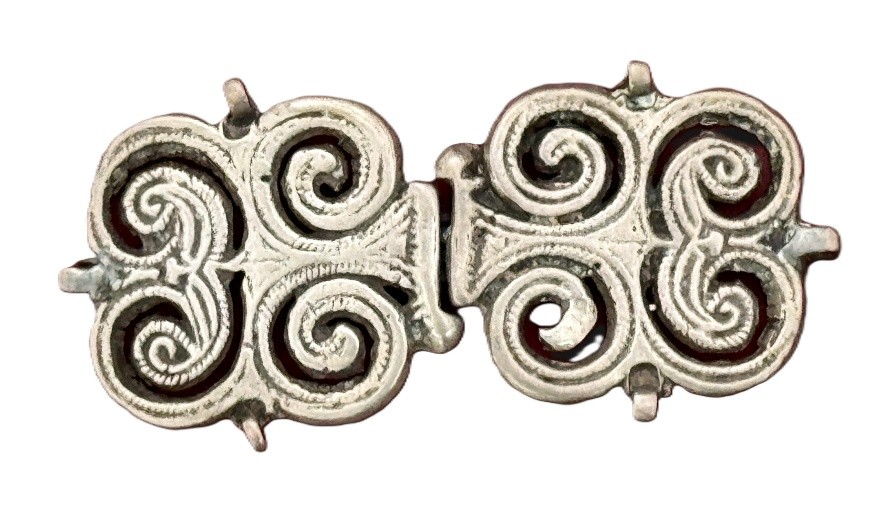
Kapsyrma (clasp). The piece is a pair of clasps consisting of two symmetrical elements connected by a central locking mechanism. The design is compact and functionally oriented, intended for fastening items of clothing.The composition is based on the principle of strict mirror symmetry. Each element has a cross-shaped, expanded structure formed by four spiral-like curls converging towards the central zone. The ornamentation draws on traditional motifs of the ‘koshqar muiz’ type yet is interpreted in an extremely generalised and plastically simplified form.The decorative design is based on the relief treatment of the surface. The curls are executed as solid cast elements with a rounded profile, which lends the form a sculptural expressiveness. The surface is further enlivened by shallow incisions and contour detailing, emphasising the dynamism of the spirals.Technologically, the piece is produced using a casting method followed by hand finishing. Unlike filigree or engraved examples, here the plastic integrity of the form, resulting from the casting technique, is dominant.The clasp demonstrates a long-standing tradition of using spiral ornamentation in Kazakh jewellery art from Eastern Kazakhstan, where decorative effect is achieved through the expressiveness of the silhouette and relief, rather than through complex techniques or the polychromatic use of materials.