
The Transformation of Traditional Values in the Age of Globalisation, 2018 Installation, felt, mixed media. Source: https://aspangallery.com
Gulnur Mukazhanova
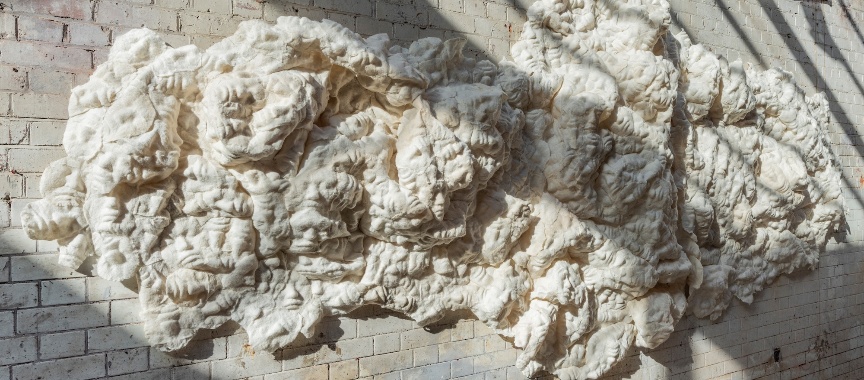
The work is built on the contrast between two visually and semantically opposed structures: orderly brickwork, which serves as a marker of historical stability, rational organisation and local cultural memory; and an amorphous mass of polyurethane foam, which functions as an image of a globalised, unstructured and expansive space. In this context, brick can be interpreted as a symbol of traditional order, embodying notions of durability, continuity and the institutional consolidation of cultural meanings, whilst the foam represents the processes of deconstruction of stable forms, the blurring of boundaries and the accelerated transformation of systems of meaning.Semiotically, this opposition can be viewed as a clash between a ‘rigid signifier’ and ‘floating signification’, where the traditional architectural structure loses its autonomous legibility, finding itself absorbed by a homogeneous mass lacking any internal hierarchy. Such a visual strategy corresponds to poststructuralist notions of the instability of the sign and the disintegration of fixed cultural codes, which allows the installation to be interpreted as a model of the transition from a culture of stable forms to a culture of fluid and indeterminate configurations.