
Dombyra. Wood, hand-carved, inlaid.
Erdos Rakymaev
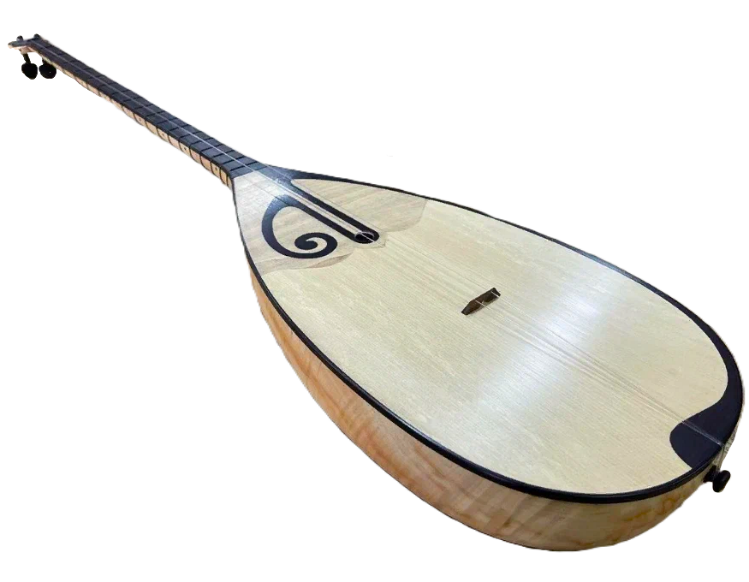
In this work, the dombra is treated not only as a musical instrument, but also as a sculpturally complete object of artistic woodwork, in which functionality is combined with the aesthetics of a contemporary, artistically crafted treatment of the material. Preserving the traditional two-stringed construction and the characteristic elongated proportions of the body, the master treats the historically established form as a stable cultural archetype.The instrument’s visual expressiveness is based on the precision of its silhouette and the restraint of its decorative treatment. The artist avoids excessive ornamentation, focusing instead on proportional structure, clean lines and the tectonics of form. As a result, the dombyra is perceived as a unified and concise whole, and its artistic image is constructed primarily through the interplay of design and material.The natural texture of the wood plays a special role. The light surface of the soundboard contrasts with the darker elements of the neck and binding, forming a clear compositional structure and emphasising the object’s architectural quality. The natural grain of the wood is not concealed by decorative treatment, but becomes an important part of the work’s artistic language.The ornamental motif at the base of the strings takes the form of a stylised spiral element, drawing on traditional Kazakh ornamentation. Its inclusion is subtle and does not disrupt the instrument’s overall sculptural restraint. The ornament functions more as a sign of cultural identity than as an independent decorative accent.