
Kapsyrma
West Kazakhstan. Silver, stamped, granulation, blackening. A. Kasteev National Museum of Arts of the Republic of Kazakhstan
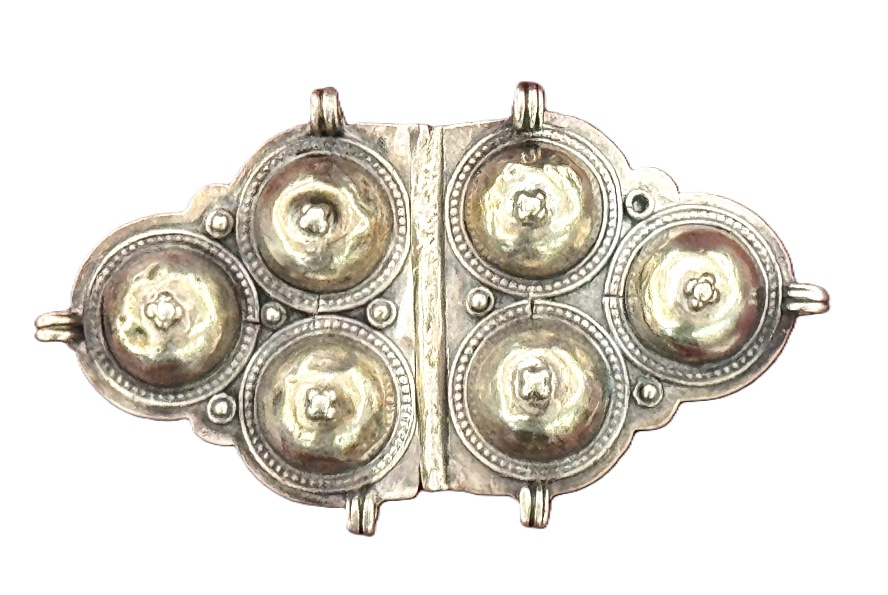
Kapsyrma (clasp). The item is a pair of clasps consisting of two halves connected by a central hinge mechanism. The design is characterised by its compactness and clear functional organisation, intended for fastening items of clothing.The composition is based on the principle of axial symmetry and modular repetition. The surface of each flap is organised as a group of hemispherical projections arranged in a regular pattern. These elements form the dominant sculptural motif, creating an effect of three-dimensional relief and visual density in the composition.The decorative design is based on a combination of smooth convex forms and ornamented frames. Each hemispherical element is enclosed within a ring-shaped frame with a fine-grained decoration (grain), which emphasises the contour and reinforces the rhythmic structure. The background areas are further treated with blackening, creating a contrast between the light, protruding forms and the darkened surface.Technologically, the piece is made using a stamping method followed by hand finishing. The hemispherical elements are formed using a punch, after which the surface is embellished with granulation and blackening to enhance the decorative effect. The hinged joint ensures mobility and a secure fastening.The clasp reflects the focus on plastic expressiveness and the rhythmic organisation of form characteristic of the Western Kazakhstani jewellery tradition, where decorative effect is achieved through the repetition of three-dimensional elements and contrasting surface treatments.