
The Walker, 2024. Chamotte. Almaty
Bagdat Sarsen
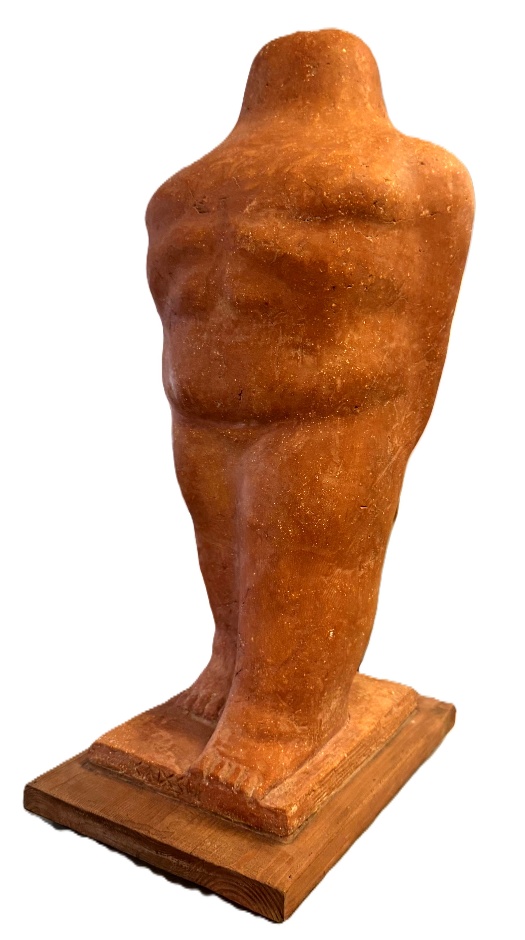
The image of the human figure in the work is highly generalised and reduced to a monolithic sculptural mass, where individual features give way to an archetypal perception of the figure. The sculpture is virtually devoid of detail and is perceived as a single volume, in which movement arises not from anatomical gesture but from the internal rhythm of the form.The figure is frozen in the act of taking a step, yet the dynamism is conveyed with deliberate restraint. A slight shift of the torso and the rotation of the legs create a sense of slow, steady movement without outward expression. Here, movement becomes not an action but a state—a sustained and continuous process of internal progression.The sculptural approach is based on a reduction of form: the upper body lacks a clear anatomical structure, and the head effectively dissolves into the overall volume. As a result, the figure loses its specificity and takes on a universal resonance. The human is presented not as an individual, but as a symbol of the journey and of existence.The chamotte retains its natural grain and traces of hand-working, which enhances the sense of density and the material weight of the form. The uniform surface, devoid of decorative accents, emphasises the integrity of the volume and its connection with the natural texture of the material.Despite the motif of movement, the composition retains a frontal orientation and an inner stillness. It is precisely this combination of immobility and movement that creates the work’s philosophical tension: the figure seems to be moving forward whilst simultaneously remaining frozen in time.The image of the ‘walker’ unfolds as a metaphor for the human journey — not a specific route, but a state of constant inner movement. The conciseness of the sculptural language and the extreme concentration of form allow the artist to create an image of profound content using minimal artistic means.