Traditional and contemporary art of Kazakhstan

A Virtual Journey into the World of Kazakhstan’s Artistic Heritage

This Web Gallery presents the diversity of artistic practices in Kazakhstan, reflecting the continuity of cultural traditions and the dynamic development of contemporary creative processes. The virtual exhibition features works based on national images, symbols, and themes, as well as artworks by contemporary artists who reinterpret the country’s cultural heritage through contemporary artistic forms, expressive means, and modern technologies.

The selected works demonstrate the relationship between traditional and contemporary art, revealing the distinctive features of the national worldview, cultural identity, and cultural meanings. The presented materials allow viewers to trace how elements of historical and cultural heritage are reflected in contemporary artistic practice, while maintaining their significance and relevance in an increasingly globalized world.

The Web Gallery is aimed at promoting Kazakhstan’s artistic heritage, expanding public access to works of art, and fostering a lasting interest in national culture and art among a wide audience.

‘Әлем білігі’ – ‘The Axis of the Universe’. 2010. Felt, felting. Photo by S. Suraganova

Zamzegul Oralbayeva
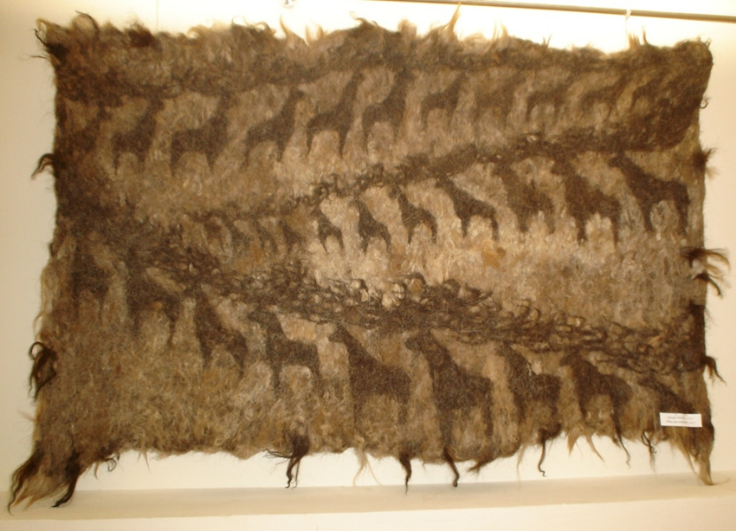
The tapestry is made from undyed wool using wet felting and art-protis (needle-punch technique).The combination of the natural palette of dark and light felt serves as a decorative accent in its own right. The density of the background, the airiness, porosity and slight three-dimensionality of the motif ‘sprouting’ from it create a contrasting binary structure within the composition.The tapestry’s space is compositionally presented as rhythmic rows formed by a protruding, ornamental motif – the figure of a deer, which alludes to the ancient cult of the sun. Through the rhythm and continuity of its repeat pattern, the recurring motif creates the illusion of a symbolic procession stretching into the distance. The absence of a border, the openness of the composition and the deliberately rough edge allow the motif to unfold visually along the horizontal axis, presenting it as a metaphor for life on the steppe, where rhythm, cyclicality and movement are defined as key categories.