
Men’s ring, silver; filigree (burama sym), granulation, blackening; hand-assembled. Source: the artist’s Instagram page — @amanatjw
Ardak Abishev
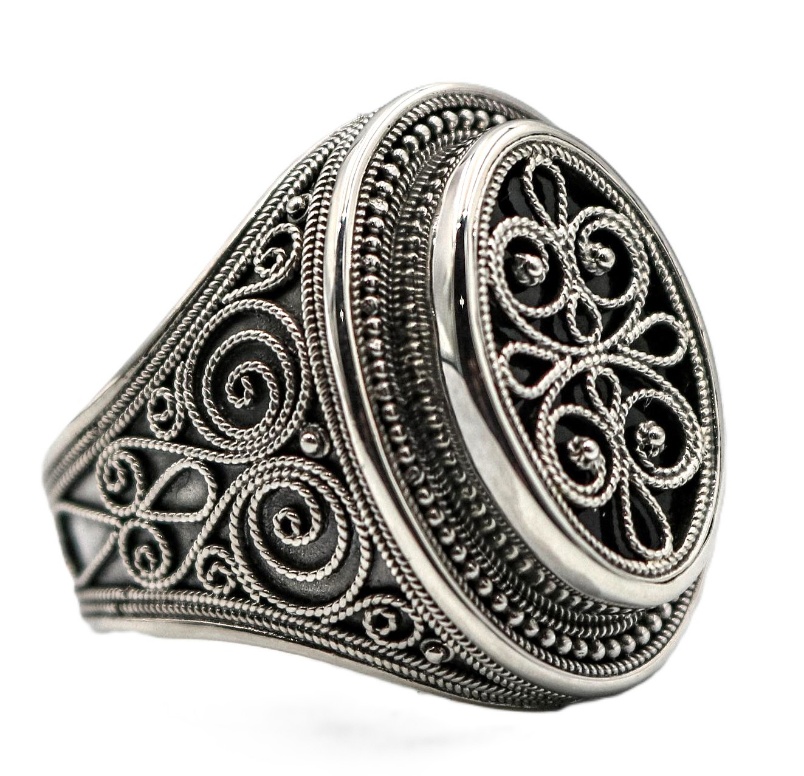
This substantial men’s ring features an enlarged oval-shaped upper surface, crafted using the openwork scan technique. The widened shank and multi-layered upper section create an expressive three-dimensional volume, lending the piece a monumental character.The composition is organised according to the principle of centrality and concentric development of form. The central field is filled with an openwork ornament of twisted wire, forming smooth spiral lines. Surrounding it are ornamental bands featuring grained and relief-worked elements. The ring’s side surfaces are also rich in spiral motifs, creating a sense of continuous decorative rhythm. Blackening enhances the contrast between the background and the ornamentation, emphasising the depth and multi-layered nature of the composition.The ring’s imagery is linked to the traditional symbolism of masculine status, strength and inner stability. The spiral elements are associated with movement, development and vital energy, whilst the scale of the design emphasises the piece’s imposing character. The ornamental structure reflects a striving for harmony and order, characteristic of traditional decorative thought.The ring is perceived as a synthesis of craft tradition and contemporary designer style, where ornamentation is combined with structural complexity and a personalised aesthetic.