
Decorative-sculptural composition, 21st century. Wood, carving
Pakhriddin Sadykov
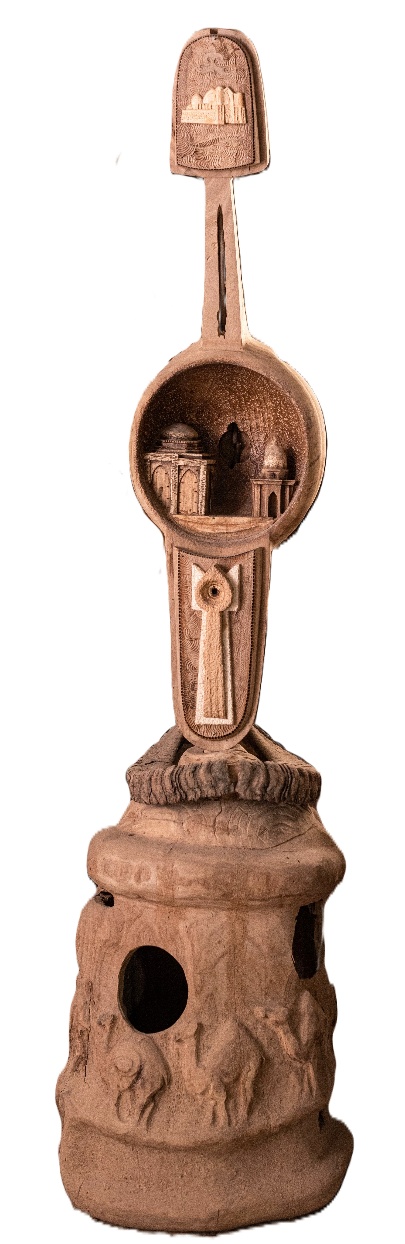
The vertical structure of the work gives the composition the character of a distinctive sculptural ‘totem’, in which elements of sculpture, architectural relief and symbolic object are combined. The work is executed in wood using the techniques of three-dimensional and relief carving and is constructed as a multi-tiered system of interrelated forms developing along a single axis.The lower section retains the wood’s deliberately rough texture and is perceived as the natural foundation of the entire composition. Traces of the carving process are not concealed but, on the contrary, emphasise the natural materiality of the wood, creating a sense of primal, almost archaic plasticity. Against this backdrop, the middle tier acquires a particular richness of meaning: the hemispherical volume unfolds as an interior space containing miniature architectural forms reminiscent of religious or sacred structures.The use of an internal ‘chamber-like’ environment significantly complicates the spatial organisation of the object. The viewer encounters not only the external volume but also a system of hidden micro-spaces that create the effect of an inner world. Thanks to this, the composition takes on the characteristics of an artistic model of cultural space, where the external sculptural volume interacts with the internal symbolic content.The upper element is designed as an elongated carved structure with rich ornamental and relief decoration. Here, the mastery of surface treatment is particularly evident: linear ornamentation is combined with three-dimensional plasticity, whilst the alternation of smooth and rough sections enhances the light-and-shadow depth of the carving. The detailed motifs contrast with the generalised treatment of the lower parts of the composition, creating a complex rhythm of perception.Semantically, the work can be viewed as a metaphor for the multi-layered nature of cultural memory, where the natural element, architectural tradition and ornamental system coexist within a single artistic field. Here, wood serves not only as a structural material, but also as a carrier of spatial and symbolic information.