
Tuyme
West Kazakhstan. Silver, stamped. A. Kasteev National Museum of Arts of the Republic of Kazakhstan
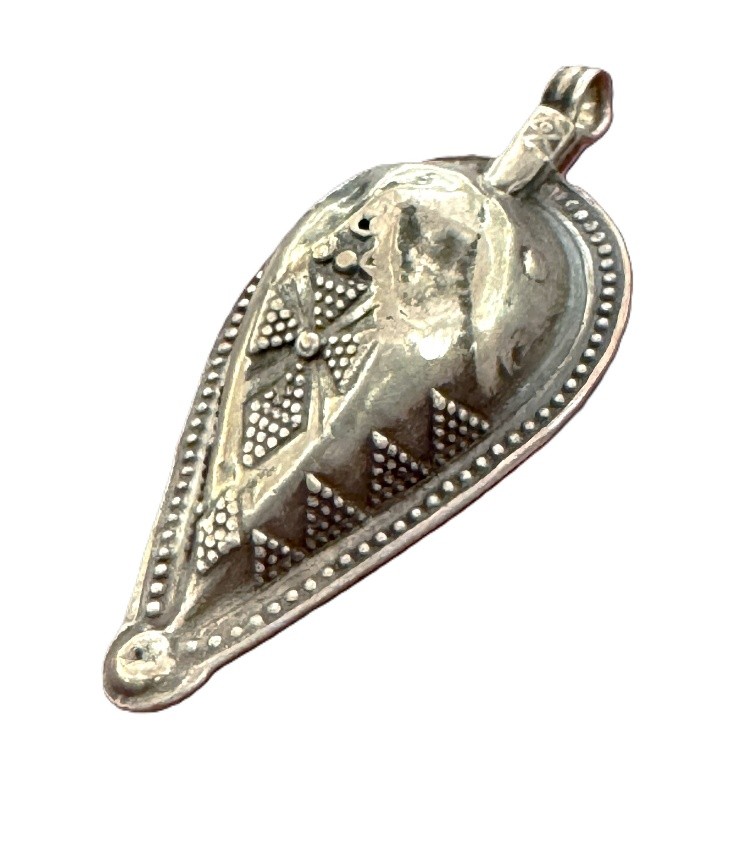
Tuyme (button). The item is a decorative button of an elongated teardrop shape with a loop for fastening at the top. The construction is made entirely of metal, in the form of a convex plate with relief ornamentation.The composition is built along a longitudinal axis of symmetry and organised within a clearly defined outline. The central field is accentuated by an elongated relief element, flanked by geometric triangular motifs forming a rhythmic pattern. An additional ornamental accent in the form of a cross-shaped motif, inscribed within a geometric grid, is introduced in the upper part of the composition.The decorative design is based on a combination of smooth convex surfaces and a textured background featuring a dotted ornament. The outline of the piece is emphasised by a series of small protruding dots forming a framing border and enhancing the silhouette’s expressiveness.Technologically, the piece is produced using a stamping method followed by hand finishing. The relief is formed by chiselling, after which the surface is refined through engraving and incising.The button reflects the characteristic features of the West Kazakh jewellery tradition of the early 20th century, where decorative effect is achieved through clear relief, the geometrization of the ornament and the conciseness of the compositional design.