
Lark, 2024. Bronze, stone. Almaty
Murat Bilal
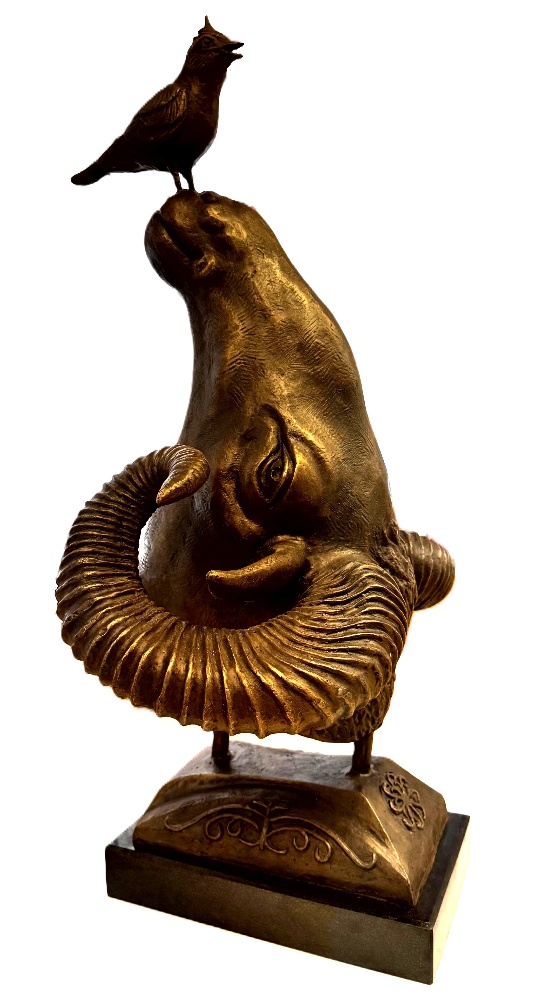
The work is built on the contrasting juxtaposition of two images — the small figure of a lark and a massive form with powerfully coiled horns, reminiscent of a ram’s head. This sculptural contrast creates a tense interplay between lightness and heaviness, between the ethereal and the earthly.The compositional rhythm is set by the spiral horns, which organise the space along a closed circular trajectory. Their flowing line sustains the internal dynamics of the entire form and directs the viewer’s gaze. The surface of the bronze has been treated in a dynamic and painterly manner: relief transitions, traces of modelling and soft indentations create a sense of living, fluid matter.The image of the lark is rendered more concisely and compactly. The slightly open beak and the figure’s taut verticality convey a moment of song, giving the composition a sense of time and inner impulse. The bird’s upward orientation stands in striking contrast to the enclosed form of the lower volume.The symbolic content of the work is built on the interaction of two archetypal images. The lark is associated with the voice of the steppe, awakening and spiritual uplift, whilst the ram stands as a symbol of strength, stability and natural energy. Their union forms a metaphor for the balance of opposites — flight and gravity, movement and stability, sky and earth.The stone base enhances the monumentality of the composition and emphasises its vertical orientation. The contrast between smooth and rough sections of bronze makes the surface visually dynamic, allowing light to actively reveal the depth and rhythm of the form.The work takes on the character of a plastic metaphor, in which the idea of inner harmony and the unity of the world’s various states is revealed through the interplay of natural images.