
Replica of an antique ring (West Kazakh tradition), silver, carnelian; casting, granulation, filigree, engraving, blackening. Source: the artist’s Instagram page — @esengaziev_jewellery.kz
Altynbek Esengaziev
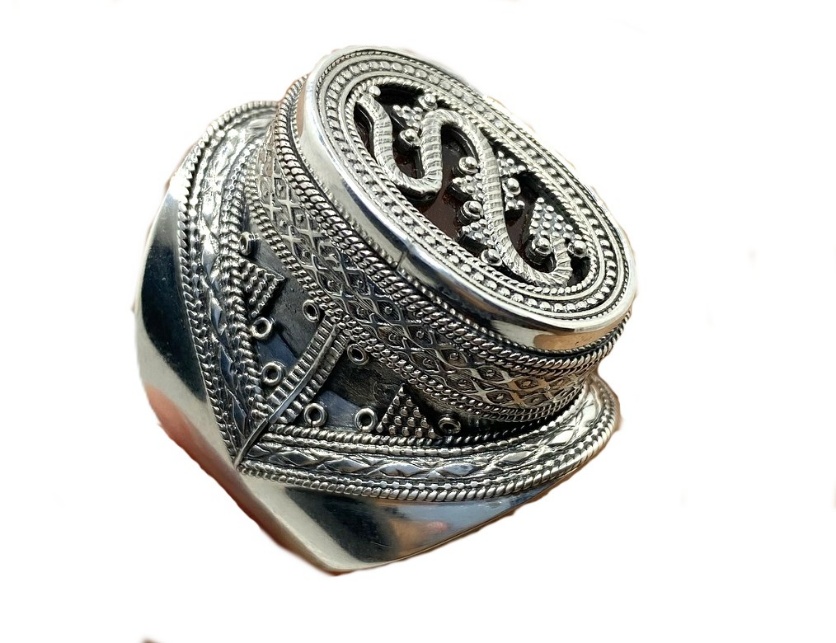
This reconstruction of a traditional ring is executed in the style of the West Kazakh jewellery school and is characterised by a solid form with an accentuated upper section. The central compositional element is an oval medallion, which dominates the overall sculptural structure of the piece.The composition is based on a combination of a monolithic shank and a multi-tiered upper section. The oval central field is decorated with an ornament executed in the zerny technique and complemented by a carnelian inlay. The side surfaces are covered with ornamental bands featuring geometric and plant motifs, creating the impression of a densely decorated surface. The use of blackening enhances the graphic contrast between the background and the relief, emphasising the expressiveness of the ornamentation.The ring’s design is linked to traditional notions of status, personal identity and belonging to a cultural milieu. In this context, the carnelian retains its significance as a stone associated with protection and vital energy, whilst the ornamental scheme reflects the idea of a harmonious and orderly world. The reference to an antique form reinforces the theme of continuity and the preservation of the jewellery heritage.The designer reproduces characteristic elements of historical jewellery, adapting them to contemporary standards of technical and decorative craftsmanship. As a result, the ring is perceived as a link between historical jewellery culture and contemporary design practice.