Traditional and contemporary art of Kazakhstan

A Virtual Journey into the World of Kazakhstan’s Artistic Heritage

This Web Gallery presents the diversity of artistic practices in Kazakhstan, reflecting the continuity of cultural traditions and the dynamic development of contemporary creative processes. The virtual exhibition features works based on national images, symbols, and themes, as well as artworks by contemporary artists who reinterpret the country’s cultural heritage through contemporary artistic forms, expressive means, and modern technologies.

The selected works demonstrate the relationship between traditional and contemporary art, revealing the distinctive features of the national worldview, cultural identity, and cultural meanings. The presented materials allow viewers to trace how elements of historical and cultural heritage are reflected in contemporary artistic practice, while maintaining their significance and relevance in an increasingly globalized world.

The Web Gallery is aimed at promoting Kazakhstan’s artistic heritage, expanding public access to works of art, and fostering a lasting interest in national culture and art among a wide audience.

I Am Still Here, 2026. From the artist’s personal archive

Madina Narbayeva
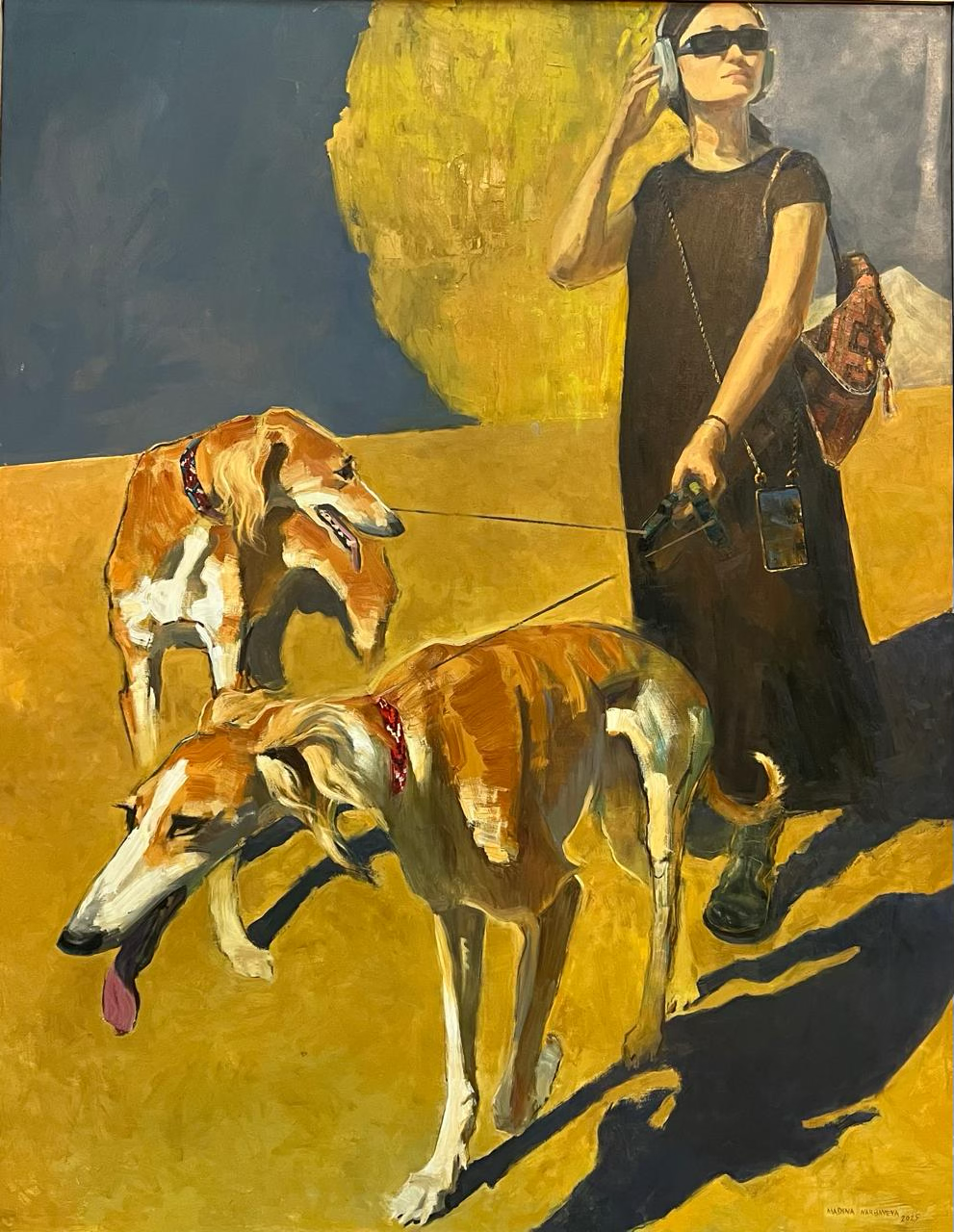
The work is a visual representation of hybrid identity within the context of contemporary Kazakhstani art, based on a synthesis of traditional and urban codes.The composition depicts a young woman in a contemporary setting, marking her as a bearer of current urban culture. At the same time, the inclusion of traditional ornamentation on her rucksack and the image of the tazy introduces elements of ethno-cultural semiotics, creating an effect of ‘dual belonging’—to the global present and to local tradition.The tazy, as a culturally significant symbol of nomadic civilisation, function as a sign of historical continuity and the stability of the national code. The colour scheme, dominated by a warm ochre-yellow background, serves to semantically integrate steppe and urban spaces, creating a metaphor for a ‘portable steppe’ within the urban environment. Stylistically, the work combines the principles of contemporary realism with an impressionistic painterly approach, evident in the free modelling of forms and the emphasis on the dynamics of movement.