
Happiness, 2024. Copper, wrought. Almaty
Rustam Shamakhunov
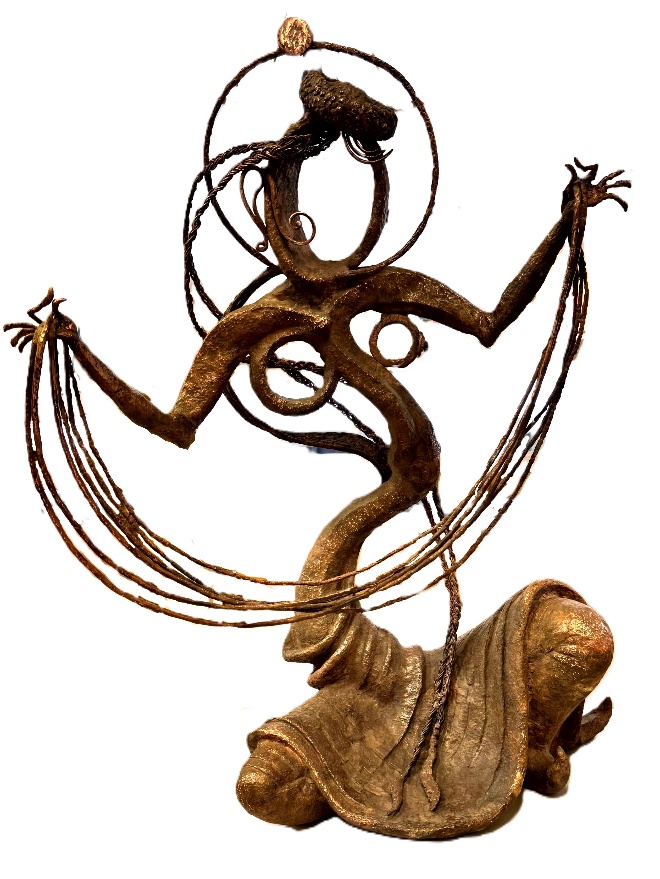
The work is built on a system of plastic associations, where the figurative element dissolves into the rhythm of lines, curves and symbolic elements. The artist eschews direct representation, forming the image through the complex interplay of dynamic and decorative structures.The central motif is a stylised anthropomorphic figure with a distinctly fluid silhouette. The S-shaped curve of the body gives the composition an internal movement and a sense of continuous energy. The arms, spread out to the sides, hold elongated linear elements resembling strings or threads, giving the form a sense of lightness and an almost musical rhythm.The upper part is organised around a circular element, perceived as a symbolic centre or a kind of halo. It unites the separate parts of the composition and maintains its spatial balance. Curls and loop-like lines reinforce the impression of continuous movement and the visual fluidity of the form.The lower part, by contrast, is characterised by greater density and stability. The generalised mass of the base contrasts with the openwork upper structure, creating a tension between heaviness and weightlessness, stability and freedom.The forged copper retains traces of handwork and the lively irregularity of the surface. The transitions from smooth to rough areas enhance the material expressiveness of the object and emphasise the processual nature of the sculpture. Light, interacting with the metal surface, renders the composition visually dynamic and changeable.The artist interprets the concept of ‘happiness’ not as a state of tranquillity, but as a fragile balance of various forces. The work is perceived as a metaphor for inner harmony arising between tension and freedom, stability and movement. Through its abstract form, the work reveals emotional and philosophical content, whilst retaining a sense of lightness and inner flight.