
‘Ring of Power’, silver, turquoise, carnelian; granulation, filigree; hinged joint. Source: the artist’s Instagram page — @ikram_zerger
Ikram Rafikov
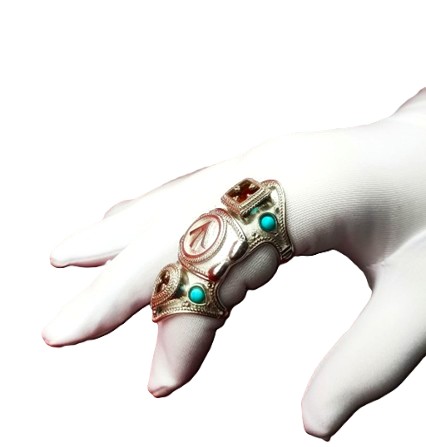
This multi-component, transformable ring is constructed using a system of hinged joints that allow the individual elements to move. The design wraps around a significant portion of the finger and, in terms of scale, resembles a statement ring rather than a traditional ring.The composition is symmetrical and centred around a large central insert, surrounded by ornately crafted elements. The sides develop into a branched structure with additional turquoise inlays and decorative modules. The surface is richly decorated with delicate filigree work: granulation and repoussé form a complex ornamental network that enhances the piece’s sculptural expressiveness.The design of the ornament is linked to notions of power, status and the symbolic significance of the ring as a sign of belonging to a particular social or cultural system. In traditional jewellery culture, carnelian and turquoise are believed to possess protective and energetic properties. The central composition is perceived as a sign of concentrated power, whilst the symmetry emphasises the idea of inner order and balance.The combination of traditional techniques with an innovative structural solution takes on particular significance in the piece. The hinged mechanism transforms the jewellery from a static object into a mobile, fluid system, bringing it closer to the principles of contemporary jewellery. As a result, the ring is perceived as a synthesis of ethno-cultural symbolism, engineering design and contemporary artistic design.