
Weaving, wool, chii.
Raushan Bazarbaeva
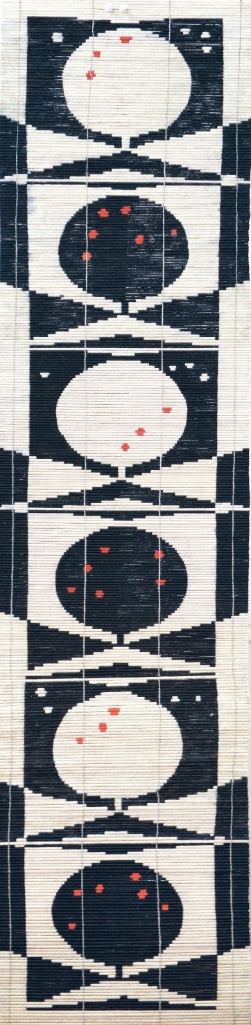
This panel is an example of geometric abstraction, in which traditional Kazakh textile practices are reinterpreted through the aesthetics of Constructivism and Minimalism. The composition is built on the precise interplay of geometric forms and rhythmic repetitions, creating a sense of cosmic order and a mathematically organised space. At the same time, the work retains a deep connection with the Kazakh worldview, based on the perception of nature and the universe as a single harmonious system.The composition is based on a vertical sequence of circles and squares, arranged according to the principle of the inversion of black and white. This alternation creates a visual rhythm reminiscent of the cyclical passage of time, the changing phases of the moon, or the structure of an ancient calendar. The vertical axis of the composition evokes associations with the sacred model of the World Tree or the symbolic axis connecting earth and sky.The interaction between the circle and the square is semiotically significant. In Kazakh tradition, the circle is associated with the image of the sun, the shanyrak and the infinite movement of the cosmos, whilst the square symbolises stability, order and the material foundation of existence. Their alternation creates a sense of balance between the spiritual and earthly principles, forming a visual model of the world order.The contrast between black and white reinforces the philosophical content of the work. The monochrome palette emphasises the dualistic nature of the world, based on the interplay of opposites — light and darkness, day and night, life and rest.