
New Melody, 2018. Oil on canvas. From the artist’s personal archive
Almas Nurgozhaev
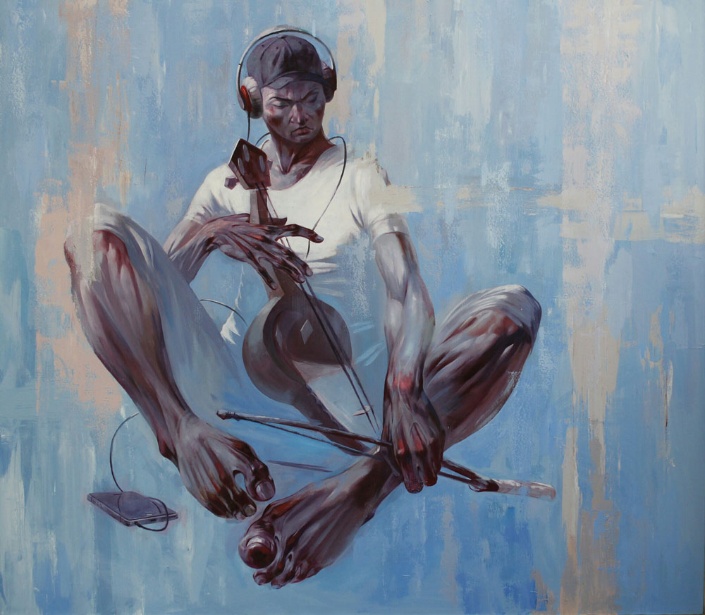
The narrative of the work centres on the figure of a young kyushi, holding two symbolic attributes in his hands — the sacred kobyz of Korkyt-Ata and modern gadgets. Through this juxtaposition, the artist explores the idea of a dialogue between tradition and modernity, illustrating the continuity of cultural values in the technological age. Here, the kobyz serves not only as a musical instrument but also as a sacred symbol of spiritual memory, whilst the gadgets symbolise the modern way of perceiving the world and communicating.The main character is depicted against the backdrop of an endless blue sky, which takes on significant philosophical meaning. The image of the sky refers to the ancient Turkic concept of Kok Tengri — the Eternal Sky as the supreme spiritual principle and the foundation of the universe. In this context, the figure of the young man is perceived as a link between the past and the present, between traditional culture and modern civilisation.The hero’s state is conveyed through a motif of inner immersion: engrossed in the music playing through his headphones, he seems to dissolve into the surrounding space. This fusion with nature and the sky emphasises the idea of human harmony with the world, characteristic of the Turkic worldview. The colour blue becomes not merely a colouristic element, but a symbol of spiritual purity, freedom and heavenly origin. The work represents a philosophical and symbolic reflection on the preservation of national identity in the modern world.