
Hope, 2024. Bronze, stone. Almaty
Nurlan Bolatbekov
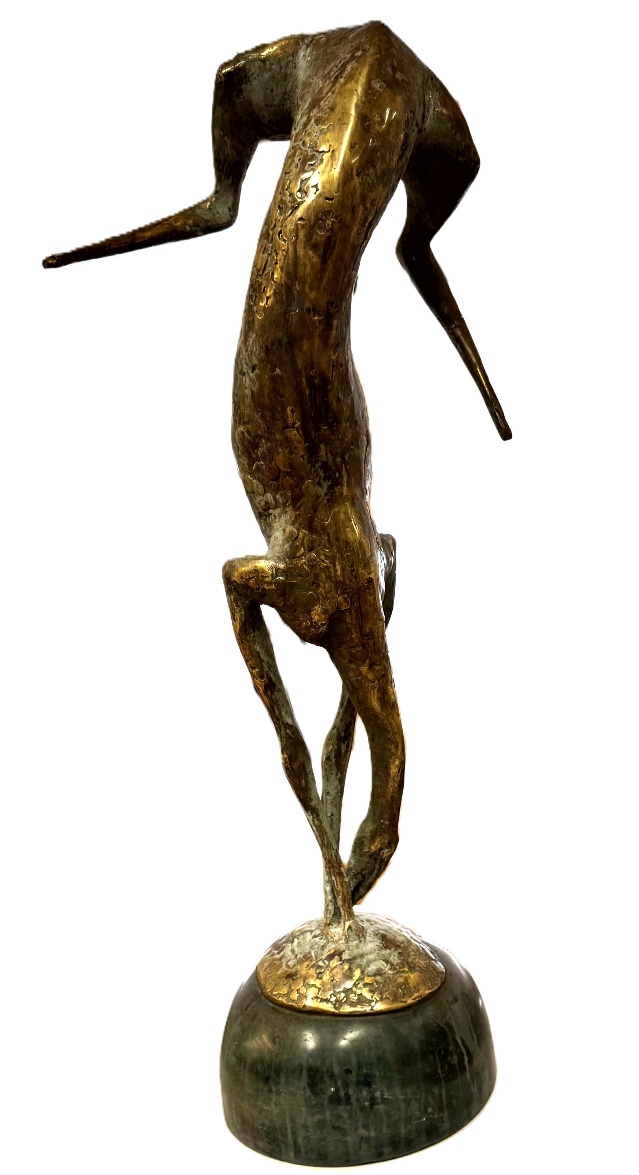
The image of the human figure in the work is taken to the extreme of plastic generalisation and is perceived as an elongated, almost abstract silhouette. The artist deliberately minimises anatomical detail, focusing attention on the internal tension of the form and the expressiveness of movement.The figure balances on a small support, creating a sense of fragility and precarious equilibrium. The crossed legs, elongated torso and asymmetrically outstretched arms form an ascending rhythm of lines directed upwards. The upper part of the silhouette is perceived as a gesture of overcoming and a desire to break out of the confines of a closed space.The sculpture is built on a combination of smooth transitions and sharp breaks. The fluidity of the forms contrasts with the tense lines of the elongated elements, allowing the composition to retain a sense of internal movement despite the external static nature of the material.The bronze surface has been treated unevenly and retains traces of modelling, reinforcing the impression of incompleteness and a living sculptural process. The stone base acts as a stable counterpoint to the figure’s fragile verticality and emphasises its internal tension.