
A Glance from the Past. Weaving, wool, chii. 2006. Source: https://roerich.kz
Natalia Bazhenova
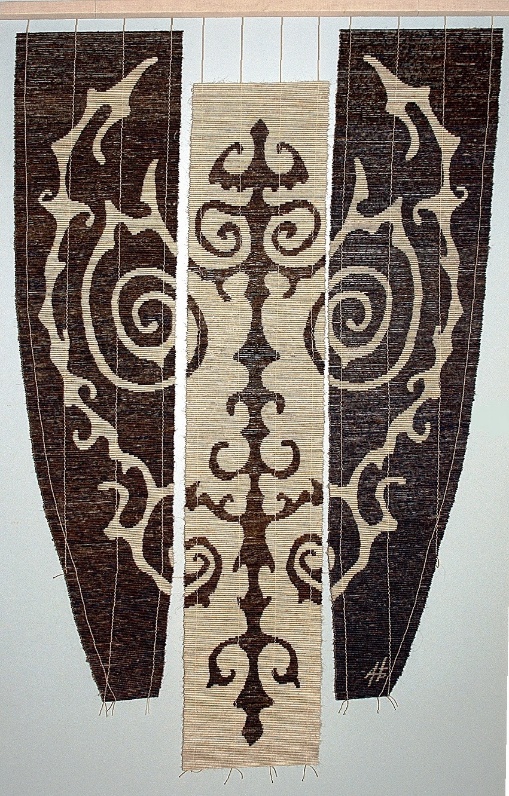
The composition is organised in the form of a triptych, which lends the work a distinctive rhythmic and symbolic structure. The division of the canvas into three independent parts creates an effect of fragmentation, reminiscent of a shattered mirror of memory. The gaps between the elements play an important role: they incorporate the surrounding space into the structure of the work and transform the wall into an active component of the composition. As a result, the work extends beyond the plane and takes on the character of an installation.The semiotic centre of the work is linked to an anthropomorphic interpretation of the ornament. The title ‘A Glance from the Past’ provides the key to its interpretation: the interweaving of lines gradually coalesces into a stylised face. This image lacks individualised features and is perceived as an archetypal image of an ancestor or a spirit of remembrance, emerging through the structure of the material. Such ambiguity reinforces the sense of a dialogue between the present and the past, between the material object and collective historical memory.The work’s ornamental system is based on the transformation of a traditional zoomorphic motif. The spiral-like elements, reminiscent of the arhar’s horns, lose their purely decorative function and take on symbolic meaning. In this interpretation, they can be perceived as eyes, traces of time or signs of ancient knowledge. The ornament becomes a kind of visual code of cultural memory, through which the past ‘looks’ at the contemporary viewer.