Traditional and contemporary art of Kazakhstan

A Virtual Journey into the World of Kazakhstan’s Artistic Heritage

This Web Gallery presents the diversity of artistic practices in Kazakhstan, reflecting the continuity of cultural traditions and the dynamic development of contemporary creative processes. The virtual exhibition features works based on national images, symbols, and themes, as well as artworks by contemporary artists who reinterpret the country’s cultural heritage through contemporary artistic forms, expressive means, and modern technologies.

The selected works demonstrate the relationship between traditional and contemporary art, revealing the distinctive features of the national worldview, cultural identity, and cultural meanings. The presented materials allow viewers to trace how elements of historical and cultural heritage are reflected in contemporary artistic practice, while maintaining their significance and relevance in an increasingly globalized world.

The Web Gallery is aimed at promoting Kazakhstan’s artistic heritage, expanding public access to works of art, and fostering a lasting interest in national culture and art among a wide audience.

Dish. Talgar settlement

From the book: Artistic Culture of Central Asia and Azerbaijan, 9th–15th Centuries. Volume II. Glass. — Samarkand-Tashkent: MICAI, 2011.
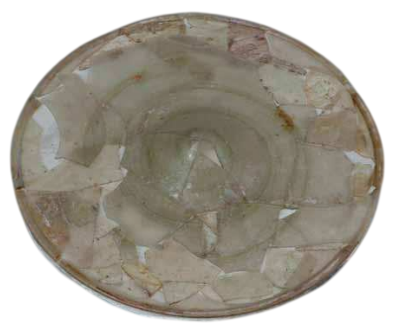
The dish belongs to the category of unpainted tableware, in which the primary aesthetic significance is attributed to the purity of the material and the expressive play of light on its surface. The absence of ornamentation is compensated for by the delicate craftsmanship of the form: concentric circles in the central part create a strict, geometrically precise composition, reinforcing the sense of order and harmony.Technological features suggest the use of the free-blowing technique. This method of production required a high level of skill, enabling the creation of elegant yet functional items for everyday use.The artefact has survived to the present day in a fragmented state and has undergone scientific restoration. The fragments have been carefully assembled, matched and secured to a transparent backing, making it possible to reconstruct the dish’s original form and ensure its integrity for display.