
Pileless carpet, 1960
1960s. Kustanai Region. Collection of the A. Kasteev State Museum of the Republic of Kazakhstan.
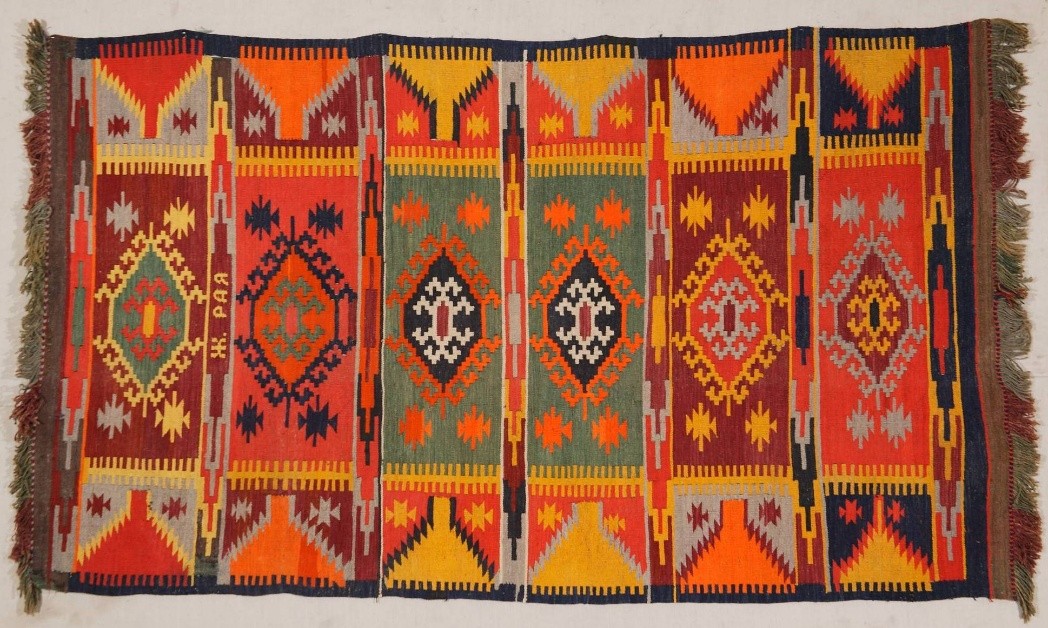
The carpet shown here is a striking example of lint-free carpets, known locally as ‘torgay kilem’. They are characterised by a rich, saturated colour palette based on contrasting combinations of red, black, white, orange and green shades.The composition of the carpet, as in previous examples, is based on the principle of vertical alternation of bands of varying widths – in this case, wide and narrow. This structure lends the ornamental field a rhythmic organisation and emphasises the axial orientation of the composition.The main focal points are large diamond-shaped rosettes. In traditional ornamentation, the diamond is associated with the symbolism of the earth, fertility and the feminine principle. On a larger scale, it takes on the meaning of the centre, stability and vitality, becoming the compositional ‘core’ of the carpet.On either side of the wide band, the weaver has placed figures resembling triangles, vaguely reminiscent of pyramids. These elements can be interpreted as stylised representations of a mountain — one of the oldest cosmogonic symbols. In the traditional worldview, the mountain was understood as a model of the universe, connecting the heavenly and earthly realms. Their symmetrical arrangement reinforces the sense of stability and balance.