Traditional and contemporary art of Kazakhstan

A Virtual Journey into the World of Kazakhstan’s Artistic Heritage

This Web Gallery presents the diversity of artistic practices in Kazakhstan, reflecting the continuity of cultural traditions and the dynamic development of contemporary creative processes. The virtual exhibition features works based on national images, symbols, and themes, as well as artworks by contemporary artists who reinterpret the country’s cultural heritage through contemporary artistic forms, expressive means, and modern technologies.

The selected works demonstrate the relationship between traditional and contemporary art, revealing the distinctive features of the national worldview, cultural identity, and cultural meanings. The presented materials allow viewers to trace how elements of historical and cultural heritage are reflected in contemporary artistic practice, while maintaining their significance and relevance in an increasingly globalized world.

The Web Gallery is aimed at promoting Kazakhstan’s artistic heritage, expanding public access to works of art, and fostering a lasting interest in national culture and art among a wide audience.

Ayak kap 20th c.

Collection of the State Museum of the Republic of Kazakhstan. 76-tk. • Mid-20th century. Almaty Region. Folk artist Sabi Kilibayeva. Velvet, fringe, coloured threads, tambour stitch
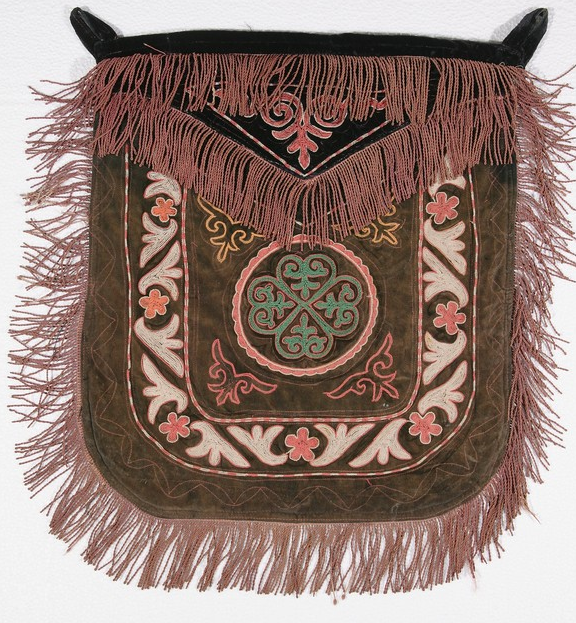
Ayaq qap — a bag designed for storing and carrying tableware (most often bowls, cups and other tableware). Such items were widely used in the interiors of nomadic dwellings and were distinguished by their decorative design.The composition of the item is based on the principle of central symmetry. The focus is on the central decorative element — a round medallion, which forms the compositional core.The medallion is situated in the centre and surrounded by an ornamental frame formed by plant motifs. A decorative border runs along the edges of the item, uniting all the elements of the composition. The upper part is adorned with a triangular flap, decorated with ornamentation and dense fringe.Fringe also runs along the sides and the lower edge of the piece, enhancing the decorative effect and lending dynamism to the composition.