
Ozhau
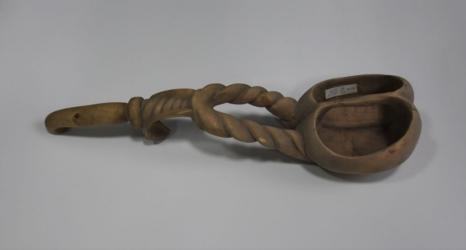
The wooden tableware group stands out for its variety of techniques and decorations used in sets or items for kymyz, a sacred and medicinal drink made from mare’s milk: ozhau – a ladle or scoop; shara or tegene – a bowl; ayak – a cup; tostagan – a small cup; saptyayak – a bowl with a handle. There are legends and songs about kymyz, and the ancient Kazakh holiday “Kymyz muryndyk” – Kumis Day on the day of the first milking of mares – is dedicated to it. Like all everyday household items in a yurt, the pispek, ozhau, shara, ayak and tostagan had a semantic meaning of transmitting knowledge of the traditional worldview. With the help of the ozhau, the kymyz in the bowl was repeatedly stirred by lifting the ladle filled with kymyz and then pouring it back into the bowl. This process of stirring kymyz is similar to a well-known plot from Turkic mythology of creation: “… the act of the birth of the Cosmos from chaos as a process of stirring, mixing the elements with a mixer or a ladle, which is the beginning of the unfolding of the Universe, its acquisition of space-time parameters” (L’vova et al. 120). The concept of sacred perfection, of everyone’s participation in the highest principle, was symbolic in nature, embodied in visible objects, “bearers of prosperity” — a vessel, as an archetypal image of the divine, and an ozhau — a trowel, which has the meaning of “a golden hitch, a banner, or a mythical mountain, i.e., objects endowed with the property of denoting the centre of the cosmos” (L’vova et al. 121) and divine substance – milk, a symbol of sacred purity (L’vova et al. 123). The forms of ozhau, made from a single piece of wood, were varied. For example, in ozhau, the handle is carved in the shape of a pigtail, curved in such a way that it rests stably on the lid of the turned vessel of the ball. The roller on the handle prevents the hand from slipping down. The ozhau ends with a hook for static fastening. The ozhau has double ladle-shaped containers and two twisted handles, which, when joined, form a protective roller and the actual handle of the ladle. The turned form of the tene is decorated with metal: a hoop that secures the walls of the vessel from cracks; handles that allow the vessel to be carried comfortably; a ferrule with scalloped edges along the edge of the vessel; and patterned plaques along the upper horizontal edge of the bowl. Carefully processed wood was often covered with silver or bone inlay. Traditional examples of ozhau, shara and tostagans preserved in domestic and foreign museums demonstrate the talented solutions of agash usta – craftsmen engaged in the manufacture of wooden tableware.