Traditional and contemporary art of Kazakhstan

A Virtual Journey into the World of Kazakhstan’s Artistic Heritage

This Web Gallery presents the diversity of artistic practices in Kazakhstan, reflecting the continuity of cultural traditions and the dynamic development of contemporary creative processes. The virtual exhibition features works based on national images, symbols, and themes, as well as artworks by contemporary artists who reinterpret the country’s cultural heritage through contemporary artistic forms, expressive means, and modern technologies.

The selected works demonstrate the relationship between traditional and contemporary art, revealing the distinctive features of the national worldview, cultural identity, and cultural meanings. The presented materials allow viewers to trace how elements of historical and cultural heritage are reflected in contemporary artistic practice, while maintaining their significance and relevance in an increasingly globalized world.

The Web Gallery is aimed at promoting Kazakhstan’s artistic heritage, expanding public access to works of art, and fostering a lasting interest in national culture and art among a wide audience.

Ağaş shelek

Aktobe Region.
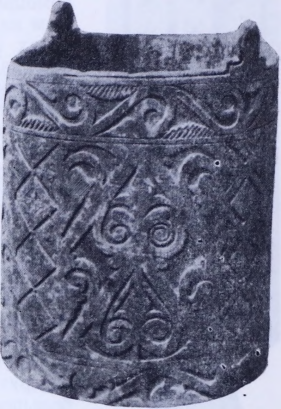
An interesting example of the use of a carved wooden bucket – a household item used in a functional role as a container for storing dishes – was cited in a study by E.A. Masanov (47). The round outer surface of the hollowed-out tree cavity is decorated with a flat relief ornament, reminiscent in its construction of the centric system of a carpet-like structure, including a central field and upper and lower borders. The upper border has preserved ornamental motifs – elements of kaz moyin with leaf-like branches and the background spaces filled with semi-leaf-like figures with thin parallel engraved lines. The central part of the bucket’s decoration is filled with two vertically constructed palmettes, one above the other, with trefoils enclosed inside them, ush zhapyrak, highlighted by engraved lines. On either side of the central motif are vertical rows of engraved rhombuses, sharshy. The ornamental pattern of the lower border is not clearly visible, but it was most likely similar to the upper border. Perhaps this bucket was used to store cups for kumis or other milk drinks – ayak.