
Sholpy
Hair ornament. 19th–20th centuries. North Kazakhstan. Silver, coins, carnelian, filigree, engraving. A. Kasteyev National Museum of Arts of the Republic of Kazakhstan
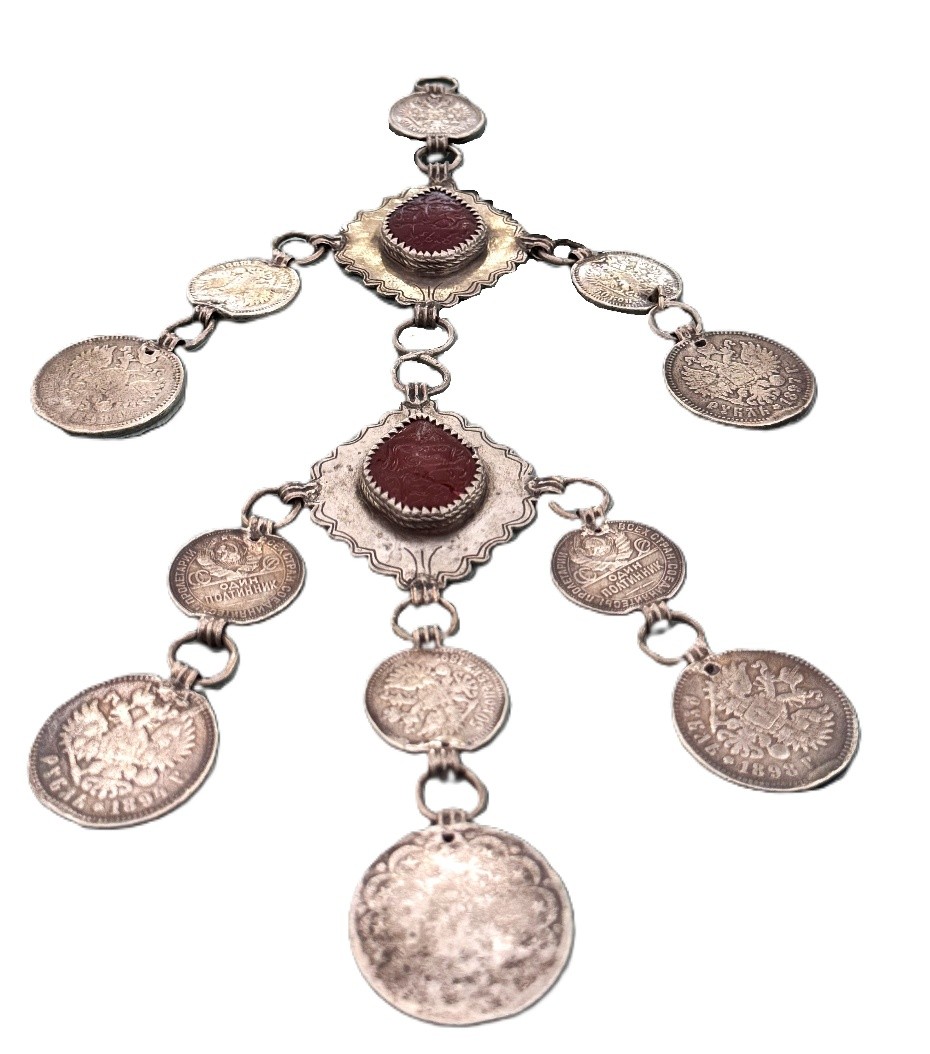
Sholpy, a pendant-style braid ornamentThe item belongs to the category of traditional hair ornaments designed to be woven into braids, serving both decorative and amuletic functions. It is characterised by a complex multi-tiered structure and a rich suspension system.The design comprises a vertically oriented composition of interconnected decorative elements. The base consists of metal plates with oval stone inlays, connected by ring links. The lower part is adorned with pendants made of coins, secured to chain elements. All parts of the structure are movable and allow for free oscillation when in motion.The composition is built on an axial principle with a pronounced vertical orientation. The central line is formed by the sequential arrangement of stone inlays, which serve as compositional accents. The side pendants and coins create a rhythmic expansion of the form and enhance its dynamic expressiveness.The ornamental scheme is based on a combination of filigree decoration and smooth stone surfaces. The metal elements are decorated with a complex openwork pattern incorporating floral and geometric motifs. Carnelian inlays provide colour accents, whilst the coins serve as decorative and symbolic elements, emphasising status and providing additional movement.The pendants create a distinct acoustic effect when in motion, enhancing the visual and auditory dynamics of the piece. Overall, the ornament demonstrates a combination of filigree craftsmanship, multi-tiered composition and symbolic richness characteristic of the North Kazakh tradition.