
Earrings
South Kazakhstan. Silver, bent, carved, embossed. A. Kasteyev National Museum of Arts of the Republic of Kazakhstan
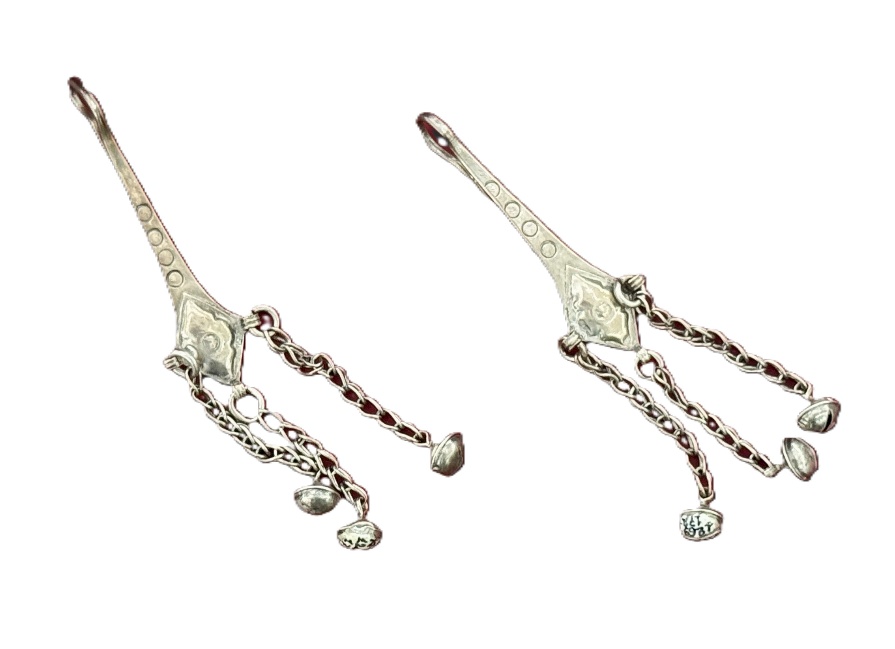
Syrga — linear, elongated drop earrings characteristic of the South Kazakhstani jewellery tradition of the 20th century. The piece belongs to the category of everyday decorative jewellery and is distinguished by its simple design with movable elements.The material is silver; the techniques used include bending, chasing and carving. The ornamentation is formed primarily through linear surface treatment and relief elements.The design consists of an elongated hoop that transitions into a lower decorative section. A triangular element is situated at the point of connection, from which chain pendants extend. The pendants are finished with small teardrop-shaped elements. All moving parts are hinged, which lends the design a sense of dynamism.The composition is built along a vertical axis with the form becoming progressively more complex towards the bottom. The upper part is minimalist, whilst the lower section is rich in pendant elements. Rhythm is created by the alternation of chains and small finials, forming a uniform structure.The ornamental scheme is characterised by restraint. The decoration is concentrated around the triangular element and on the surface of the temple in the form of dot and line motifs. The pendant elements serve not only a decorative but also an acoustic function, creating a subtle sound effect when in motion. Overall, the piece demonstrates a tendency, characteristic of traditional jewellery art, to combine simplicity of form with dynamic ornamentation.