
Ongirzhiek
19th-century breast ornament. West Kazakhstan. Silver, gilding, stamp, glass. A. Kasteyev National Museum of Arts of the Republic of Kazakhstan
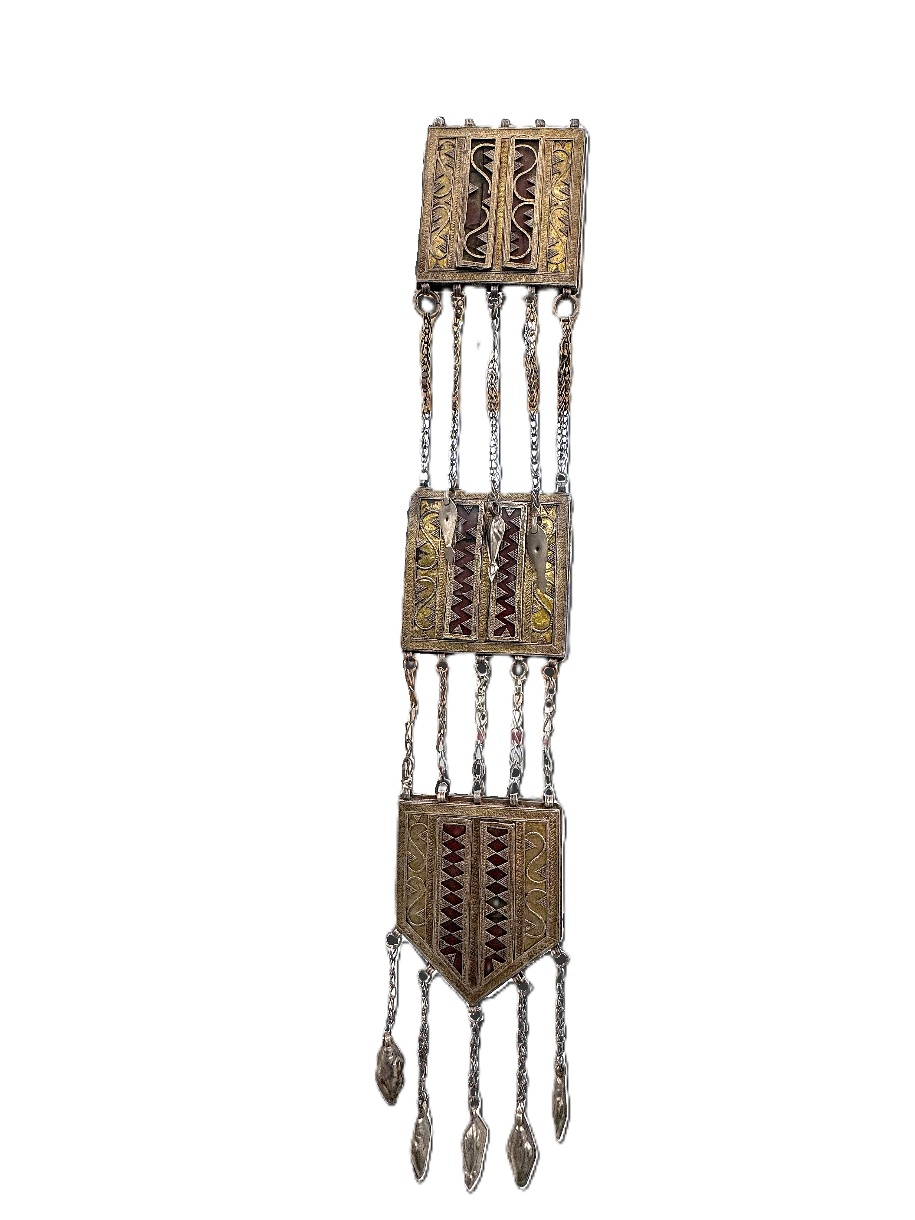
Ongirzhiek, a plate-and-pendant-style breast ornament. The piece belongs to the category of ceremonial and status-symbol neck and chest ornaments, which formed an important part of women’s costume and served both decorative and protective functions.The design consists of a vertically oriented composite system of three plates of varying shapes, connected by chain-like elements. The upper two plates are rectangular in shape, whilst the lower one is trapezoidal and pointed. All elements are connected in a movable manner, ensuring the flexibility of the structure. The lower part is complemented by teardrop-shaped pendants.The composition is built on a strictly axial principle with a pronounced vertical orientation. The plates are arranged sequentially, forming an elongated structure, rhythmically divided by chain links. The central zones of each plate are accentuated by ornamental inserts, creating compositional focal points and uniting the individual elements into a coherent system.The ornamental system is based on a combination of geometric motifs. The surfaces of the plates are decorated with stamped ornaments, predominantly featuring zigzag and diamond-shaped elements. Coloured glass inlays create contrasting accents, enhancing the decorative expressiveness. Gilding highlights the ornamentation and creates a variety of colours against the silver background.The suspended elements enhance the piece’s dynamism and serve an acoustic function when in motion. Overall, the ornament displays the clear compositional structure, rhythmic organisation and combination of decorative elements with symbolic richness characteristic of the West Kazakh tradition.