
Bilezik
West Kazakhstan. Silver, glass, gilding, hallmark. A. Kasteyev National Museum of Arts of the Republic of Kazakhstan
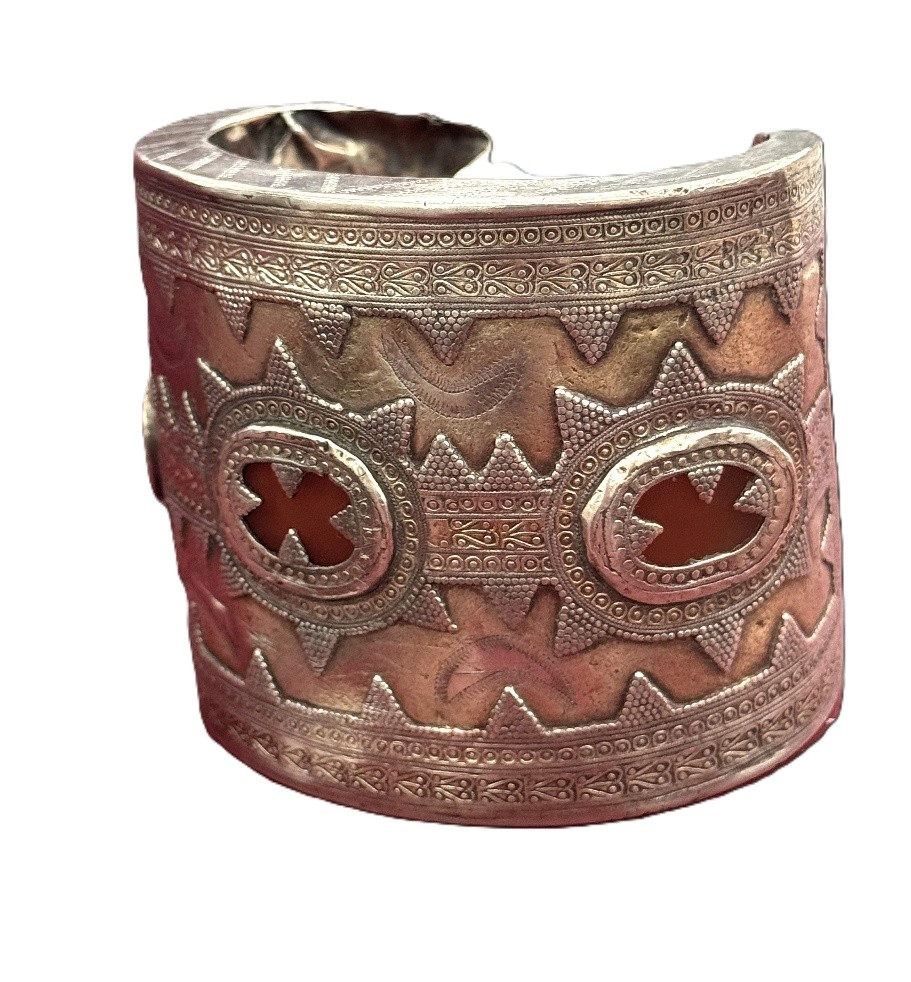
Bilezik — a cuff-style wrist ornament characteristic of traditional 19th-century Kazakh jewellery art. The piece belongs to the category of ceremonial jewellery and likely served a status-symbol and decorative function as part of a woman’s costume.The material is silver with gilding; the decorative inlays are made of coloured glass. The techniques employed include stamping, chasing and a grain-like relief decoration. The use of gilding enhances the contrast between the background and the ornamental elements, lending the piece additional expressiveness.The design consists of a wide, open bracelet form with a solid plate-like base. The ends are slightly thickened and smoothed, ensuring comfort when worn. The main volume is concentrated in the central zone, where the decorative elements are placed.The composition is structured according to the frieze principle, with a clear division of the surface. The central field is occupied by an ornamental band featuring alternating large oval medallions, into which glass elements are inserted. The medallions are framed by serrated, ray-like forms, creating an effect of radial radiance. Between them are geometric connecting elements that form a rhythmic structure.The ornamental scheme combines geometric and solar motifs. The ray-like elements around the inlays are interpreted as stylised solar symbols, which is characteristic of traditional symbolism. The surface is further enriched with a fine-grained decoration that enhances the piece’s textural quality. The contrast between the gilded and silver sections, as well as the use of coloured inlays, creates an expressive artistic image that emphasises the decorative and symbolic significance of the ornament.