
Yuzik
West Kazakhstan. Silver, carnelian, granulation, stamping, repoussé, engraving, filigree. A. Kasteyev National Museum of Arts of the Republic of Kazakhstan
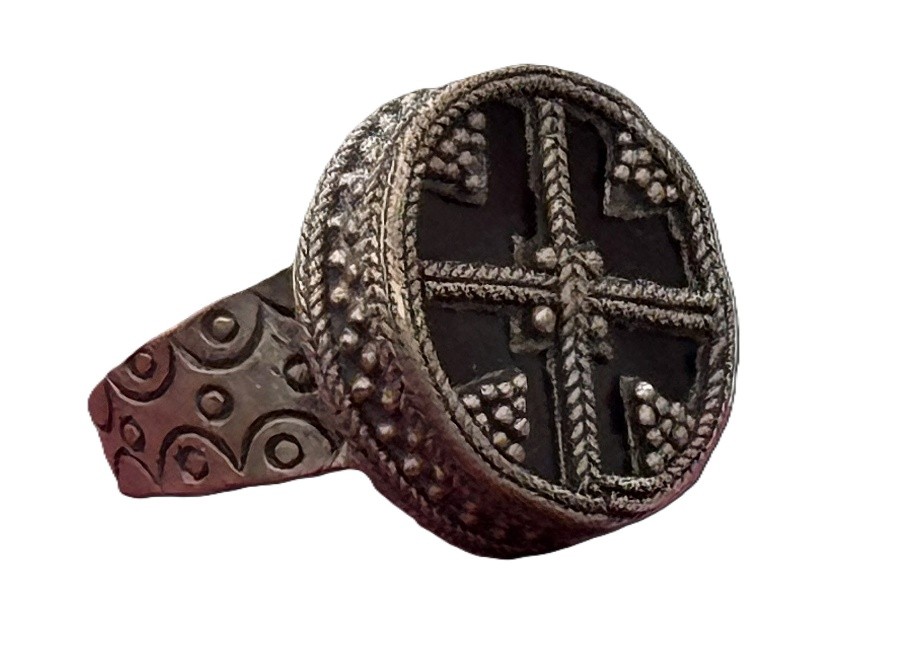
Ring (juzik) with an oval shield and a cross-shaped composition. The ring belongs to the category of traditional women’s jewellery of a status- and amulet-related nature, in which the decorative system is closely linked to a symbolic function.The design features a solid shank widening at the top, transitioning into a large oval shield. The shield is raised above the base and framed by a relief border with granulation decoration. In the central part is a carnelian inlay, set in a cast and divided into four sectors by overlay elements.The composition is structured according to axial and cruciform principles. The central field is organised in the form of an equilateral cross, formed by filigree partitions. The intersection of the axes is accentuated by an additional granulation element, which reinforces the compositional centre. The four sectors are filled with granulation-like groups, creating rhythmic symmetry.The ornamental system combines a geometric structure with a grain-like decoration. The cross-shaped motif has a well-established symbolic interpretation associated with the ideas of protection and the ordering of space. The carnelian inlay reinforces the ornament’s semantic aspect, traditionally associated with life energy and protective properties. Overall, the piece demonstrates the Western Kazakh school’s characteristic striving for clear compositional organisation and richly textured surface treatment.