
Men’s belt
Early 20th century. Semipalatinsk Region. Leather, metal, carnelian, carving, stamping and engraving. A. Kasteyev National Museum of Arts of the Republic of Kazakhstan
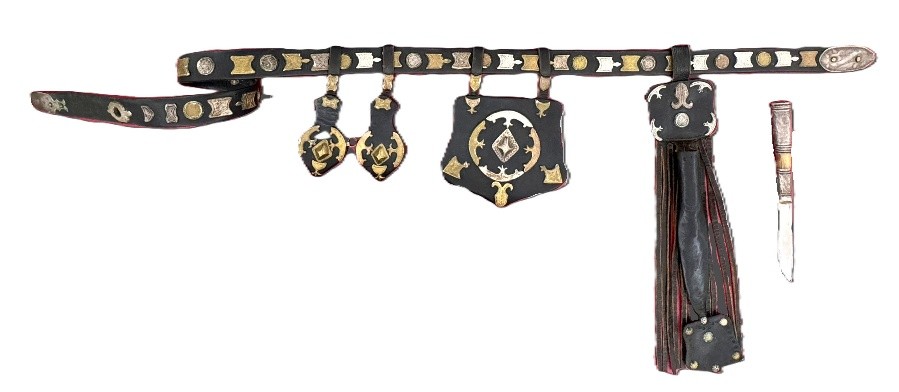
Er beldigi (men’s belt) with pendant elements. The item belongs to a complex type of belt and fastening ornamentation, fulfilling simultaneously functional, decorative and status-representative roles in men’s attire. The belt served not only as a means of securing clothing, but also as a base for attaching hanging objects of utilitarian and symbolic significance.The design comprises a leather base, along the entire length of which metal plates of various shapes are affixed. Functional elements—a scabbard, a pouch and decorative pendants—are suspended from the belt, secured by leather straps. The composition is structured along a linear principle with an emphasis on the right side, where the main set of hanging elements is concentrated.The ornamental scheme combines geometric and stylised zoomorphic motifs. The metal plates are executed in the form of rhythmically repeating shapes with a contrasting alternation of light and dark elements. The central pendants feature large compositions with a symmetrical structure, incorporating carnelian inlays.The decorative finish includes engraving, stamping and metal carving, which create a complex relief and emphasise the sculptural expressiveness of the forms. The contrast between the leather base and the metal elements enhances the visual dynamism of the piece.Overall, the belt demonstrates the tradition, characteristic of men’s costume, of integrating utilitarian objects into a unified artistic system, where structural logic is combined with a developed ornamental scheme and symbolic richness.