
Women’s saddle
Wood, felt, velvet, metal, silver inlay, stamping, enamel, filigree, granulation, inlays. A. Kasteev National Museum of Arts of the Republic of Kazakhstan
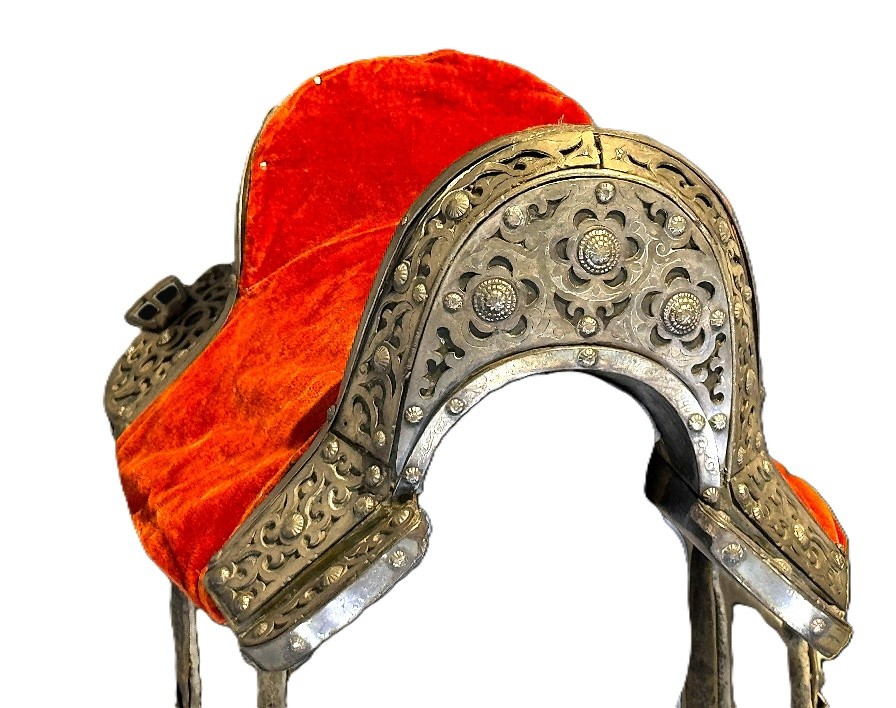
Aiyelder eri (women’s saddle) The item is a traditional women’s saddle, crafted as a complex composite object combining a utilitarian structure with an elaborate decorative system. The base consists of a wooden frame forming a characteristic high front bow with an arched cut-out.The surface of the saddle is partially covered with textile upholstery (bright red velvet), creating a striking colour accent and contrasting with the metal elements. The metal cladding on the front and side sections is made of silver and decorated using the techniques of chiselling, stamping and engraving.The ornamental scheme features plant motifs (rosettes, scrolls, stylised floral elements) arranged in symmetrical compositions. The central areas are accentuated by round decorative elements with granulation, creating a relief texture. The contour lines are reinforced by scanned elements, lending the ornament graphic clarity and an openwork quality.The composition is based on the principle of axial symmetry, with a clear distinction between the centre and the periphery. The sculptural form emphasises the functional zones of the saddle, whilst the decorative elements are integrated into the structure without compromising its practical purpose.Technologically, the piece demonstrates the comprehensive application of various jewellery techniques: silver engraving on a metal base, stamping of applied elements, filigree and granulation for ornament detailing, as well as the use of coloured inlays.This saddle belongs to the category of household items of high status and representational significance. It reflects the distinctive features of the artistic culture of 19th-century Kazakh society, where everyday objects simultaneously served to demonstrate the owner’s social standing and aesthetic preferences.