
Balbaly, 1991 Qushqon: leather, embossedSource: Catalogue of the A. Kasteev National Museum of the Republic of Kazakhstan, ‘Decorative and Applied Arts of Kazakhstan’, 2025
Zhangir Umbetov and Amangul Ikhanova
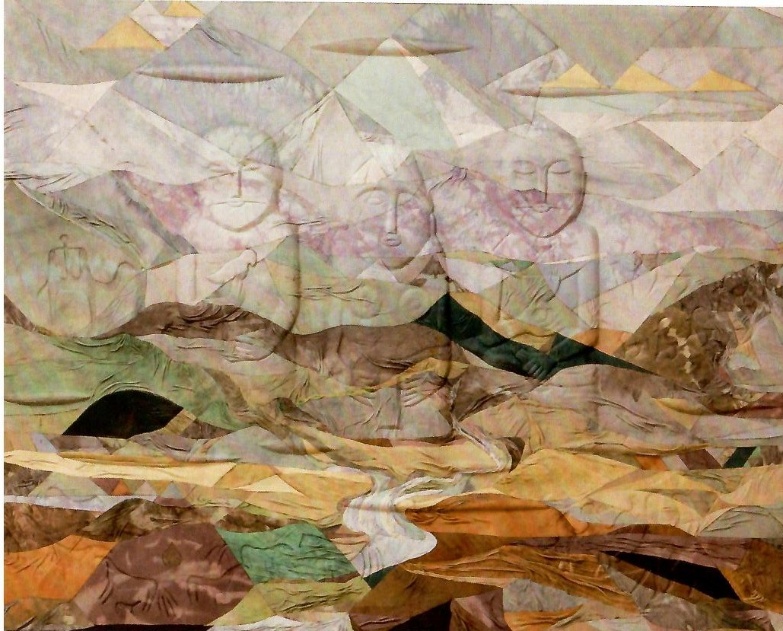
The compositional centre of the work is formed by three balbals — monumental anthropomorphic stelae which, in traditional culture, served memorial and sacred functions. In the artists’ interpretation, these images transcend the status of archaeological artefacts and take on the significance of symbols of generational continuity, collective memory and the spiritual connection between a person and their native land.A distinctive feature of the compositional design is the seamless integration of the balbals into the natural landscape. Their silhouettes seem to emerge from the expanse of the steppe and mountains, becoming an integral part of the surrounding environment. This artistic technique emphasises the idea of the unity of humanity, nature and history, characteristic of the traditional worldview of nomadic peoples. The balbals are perceived not as separate objects, but as a kind of guardians of the space, embodying the presence of ancestors in the contemporary cultural landscape.The complex three-dimensional structure of the work plays a significant role in creating its artistic image. The surface of the panel is formed from numerous geometrically arranged fragments of leather of varying textures and shades. The mosaic-like composition creates an effect of spatial layering and is reminiscent of the tectonic structure of rock formations or ancient archaeological strata. An additional layer of meaning is formed by the barely discernible relief images of petroglyphs, zoomorphic figures and archaic symbols, integrated into the landscape. The colour scheme is based on subtle transitions between earthy ochre, sandy, grey-pink and muted green shades. The multi-layered colour scheme reflects the natural conditions of the steppe landscape, the texture of ancient stone and weathered rock formations. The restrained palette reinforces the sense of archaism and creates an atmosphere of meditative contemplation, encouraging the work to be perceived as a space of cultural memory.