
‘Door. Nostalgia’, 2024. Mixed media: wood, metal, dyes, horsehair.
Aizhan Bekkulova, Abdulla Nauryzbaev
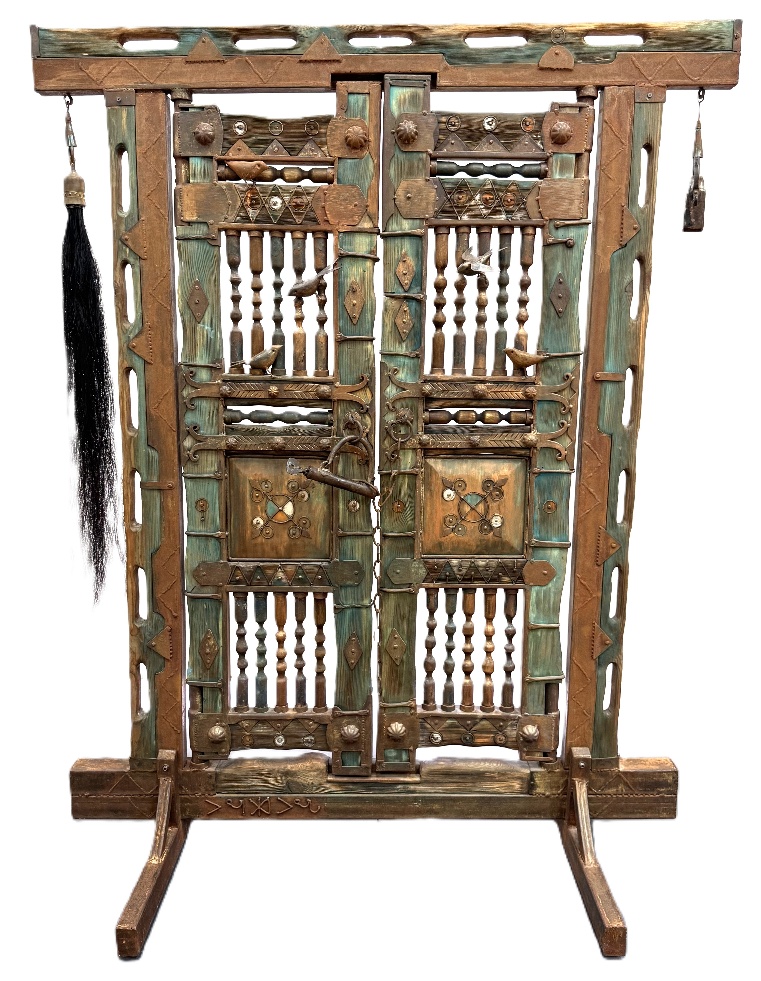
This work is based on an authentic yurt door — a sykyrlauyq — reimagined by the artists as an independent artistic object. While retaining the traditional double-leaf construction with vertical posts and cross-bars, the object loses its purely utilitarian significance and becomes a vehicle for complex plastic and symbolic content.The composition’s particular expressiveness is shaped by the multi-layered texture of the surface. Carvings, metal inlays, suspended elements and the incorporation of horsehair create a rich material environment in which every component contributes to the construction of the artistic image. The ornamental motifs do not reproduce tradition literally, but are filtered through the artist’s interpretation, combining archaic forms with the language of contemporary art.The effect of artificial ageing plays a significant role. The patinated surface, scuffs and emphasised texture variations create a sense of temporal depth and transform the object into a unique ‘trace of memory’. As a result, the door is perceived not as a reconstructed ethnographic artefact, but as an artistic reflection on time, loss and cultural continuity.The composition’s dynamism is enhanced by suspended details and zoomorphic elements associated with the natural symbolism of nomadic culture. Here, metal serves not only a structural function but also becomes an important sculptural accent, creating a striking contrast with the warm texture of the wood and the organic quality of the horsehair.The spatial and symbolic nature of the object is linked to the image of transition and boundaries. The door functions as a metaphor for the interaction between past and present, traditional and contemporary, material and spiritual space. In this instance, a real object from nomadic life becomes a mediator of cultural memory and, at the same time, a contemporary art object.