
The Nest, 2016. Oil on canvas. From the artist’s personal archive
Seisenhanuly Bakhyt
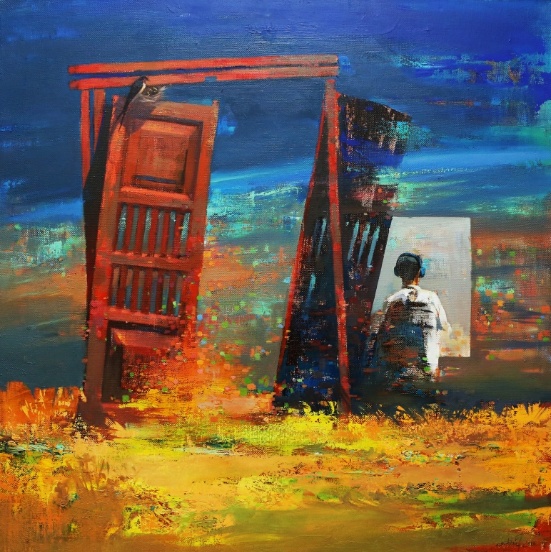
The painting ‘The Nest’ is a philosophical and symbolic composition in which the artist addresses the themes of home, memory, the inner world of the individual, and the search for one’s place in life. The work is built on a concise yet expressive combination of concrete forms and rich emotional colouring.The central compositional element is a structure made of doors, reminiscent of both an entrance and a gate. In artistic tradition, the door is a multi-layered symbol: it signifies a transition, a boundary between the inner and outer worlds, the past and the future, reality and the spiritual realm. The title ‘The Nest’ reinforces this symbolism, linking the image with the idea of home as a place of protection, comfort, birth and a return to one’s roots.The figure of the artist, depicted from behind, reinforces a sense of solitude and contemplation. The figure faces a light-coloured rectangle, reminiscent of a canvas, a window or a light source. This motif can be interpreted as a search for meaning, creative inspiration or a quest for spiritual knowledge. The absence of detailed features renders the image universal, allowing the viewer to associate it with any person engaged in a state of inner searching.The colour scheme of the painting is highly emotionally expressive.