
‘Aspanda’, 2022. Photograph by Zh. N. Shaigozova
Abylkhai Asel
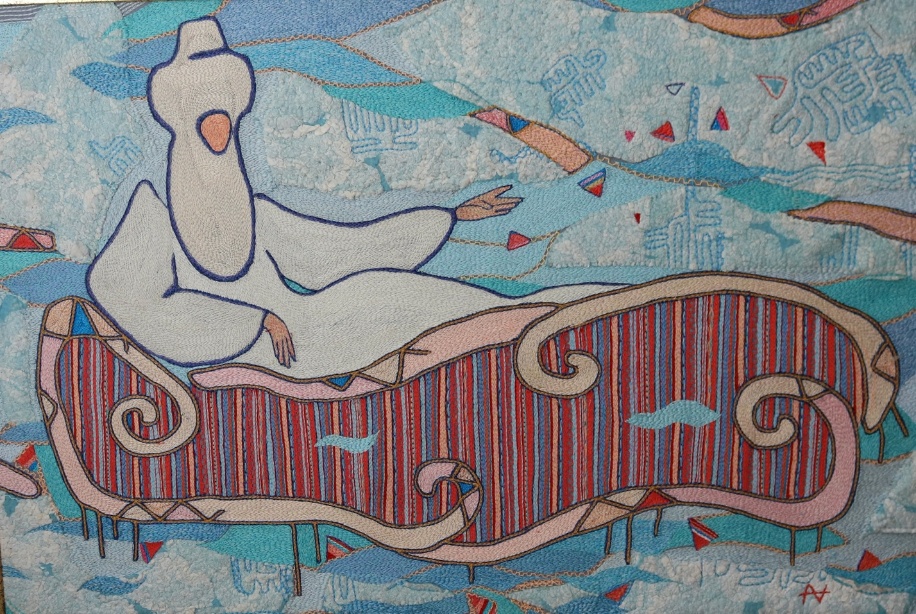
The work ‘Aspanda’ continues the tradition of contemporary Kazakhstani textile art, in which traditional cultural codes are transformed into universal visual metaphors.At the centre of the composition is a figure in white robes, interpreted as the image of a sacred character — the primordial mother Umai. In this context, the colour white symbolises purity, spiritual clarity and a transition to another, immaterial state. The figure itself is not static: it is not merely depicted in space, but visually ‘hovers’, which reinforces the sense of transcending earthly reality.The object upon which the figure is positioned is of particular significance. It is perceived as a multi-layered symbol, bringing together several cultural archetypes: the cloud as a sign of the heavens, the flying carpet as an image of journeying between worlds. This combination of images forms a complex semiotic structure in which the upward movement signifies both spiritual ascension and a return to one’s origins.The figure’s gesture, directed towards the small geometric elements, can be interpreted as an act of blessing, creation or establishing a connection with the cosmic order.