
Kapsyrma, clasp, silver; casting, engraving, granulation, blackening, hinged joint. Source: the artist’s Instagram page — @jeweller_erbulan
Erbulan Nurakhmet Bayarkhan
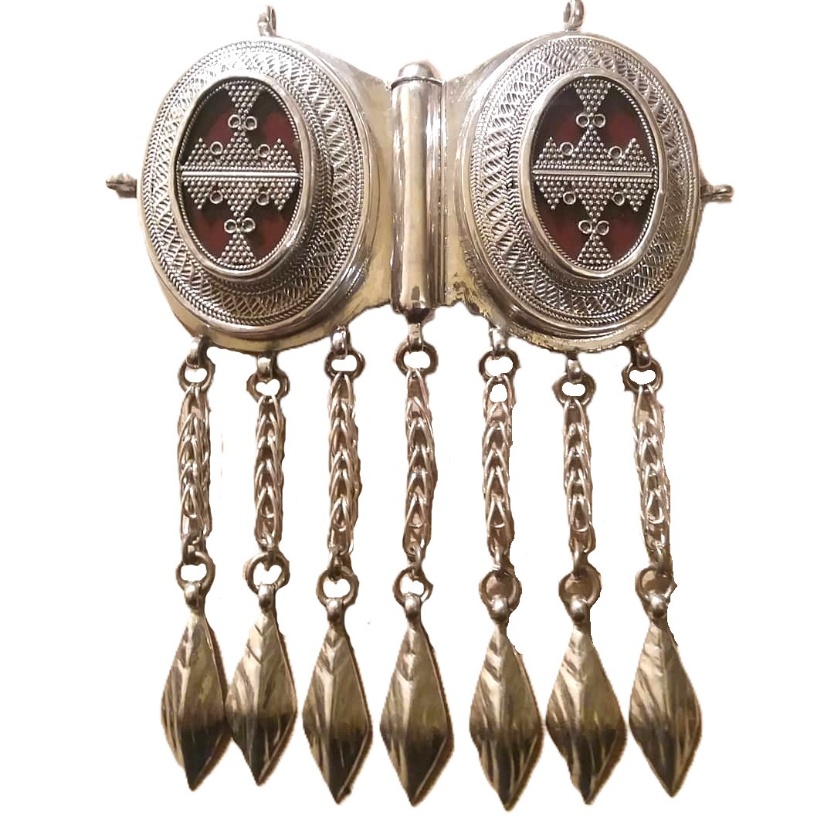
The traditional clasp — kapsyrma — is crafted as two symmetrical halves connected by a hinge mechanism. Despite its utilitarian purpose, the design features a sophisticated decorative system and is perceived as an independent work of art.The composition is based on the principle of strict axial symmetry. The rounded flaps open out from the central joint, forming a unified sculptural form. The central sections are adorned with oval medallions featuring an ornament executed in the zerny technique and complemented by dark-coloured inlays. The surface is surrounded by an intricate frame with geometric motifs, creating the effect of a dense decorative texture. The lower part is complemented by hanging elements that form a rhythmic vertical line and lend the decoration a sense of movement.In traditional culture, the kapsyrma is associated with the idea of connection, stability and wholeness. The hanging elements reinforce the protective nature of the ornament, creating a gentle sound effect when in motion, characteristic of many amulet forms. The ornamental system reflects notions of order, harmony and the structured nature of the world, as enshrined in the traditional decorative language.The particular interest of the work lies in the combination of functionality and high decorative expressiveness. The artist preserves the canonical form of the traditional clasp, whilst enhancing its sculptural and ornamental complexity. As a result, the kapsyrma transcends the boundaries of a purely utilitarian object and is perceived as a work of contemporary jewellery art that preserves the continuity of national tradition.