
Cello, 2024. Metal, tinted. Aktobe
Marat Gabdrakhmanov
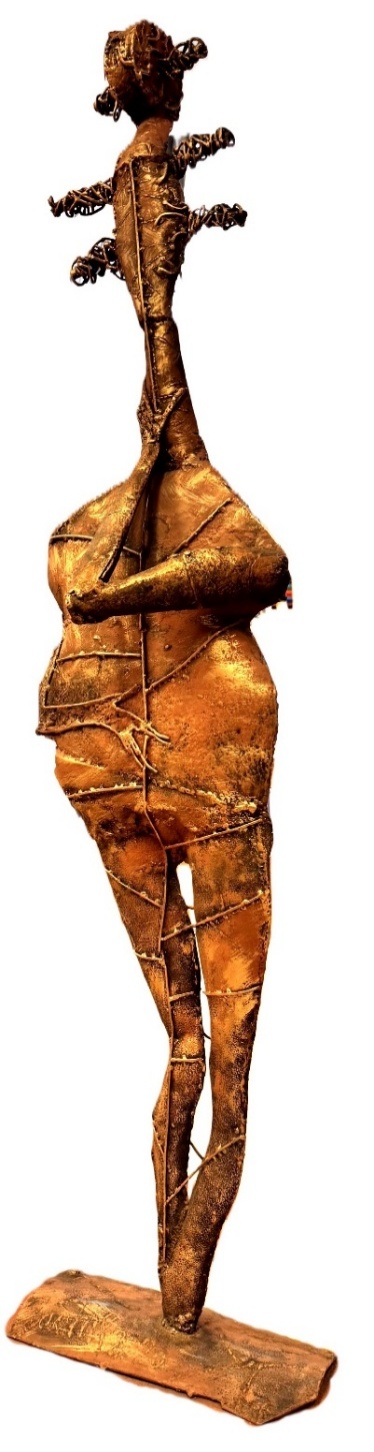
In this work, the human figure and the image of the cello are united into a single plastic system, where the musical instrument is not depicted literally, but reinterpreted through rhythm and the construction of form. The sculpture is built on an associative resemblance: the elongated silhouette of the figure echoes the contours of the cello’s body, whilst the smooth expansion and contraction of volumes creates a sense of musical harmony.The arms are reduced to a minimum of sculptural volume and serve a primarily structural function, holding the composition in a state of internal equilibrium. The linear metal frame encircling the body resembles strings whilst simultaneously revealing the form’s internal tension. These elements organise the surface rhythmically, enhancing the sensation of the sculpture ‘resonating’.The head is treated symbolically and integrated into the overall flow of the sculpture. The upper part of the composition is perceived as the focal point of the sound impulse, whilst the lower part is associated with the resonating body of the instrument. As a result, the entire form takes on the character of continuous vibration.The texture of the metal is built on a combination of smooth and rough areas. The tinted surface actively interacts with light, revealing the relief and depth of the sculptural layers. This creates an effect of ‘resonant matter’, where light becomes a visual analogue of a musical tone.In this work, music is interpreted as a plastic state. The artist translates the acoustic phenomenon into the language of volume and rhythm, blurring the boundary between the human body and the musical instrument. The sculpture captures not a specific moment of performance, but the very nature of sound as a continuous internal movement.