Traditional and contemporary art of Kazakhstan

A Virtual Journey into the World of Kazakhstan’s Artistic Heritage

This Web Gallery presents the diversity of artistic practices in Kazakhstan, reflecting the continuity of cultural traditions and the dynamic development of contemporary creative processes. The virtual exhibition features works based on national images, symbols, and themes, as well as artworks by contemporary artists who reinterpret the country’s cultural heritage through contemporary artistic forms, expressive means, and modern technologies.

The selected works demonstrate the relationship between traditional and contemporary art, revealing the distinctive features of the national worldview, cultural identity, and cultural meanings. The presented materials allow viewers to trace how elements of historical and cultural heritage are reflected in contemporary artistic practice, while maintaining their significance and relevance in an increasingly globalized world.

The Web Gallery is aimed at promoting Kazakhstan’s artistic heritage, expanding public access to works of art, and fostering a lasting interest in national culture and art among a wide audience.

Ush zhuz. From the book by Mukhamedzhan Z., *The Art of Kazakh Embroidery*. – Almaty: Almatykitap, 2008.

Mukhamedzhan Zeynelkhan
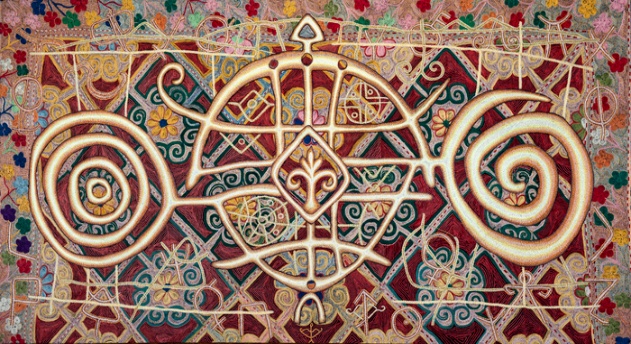
The work ‘Ush zhuz’, created using the tambour embroidery technique, represents a symbolic interpretation of the unity of the three Kazakh zhuz. The composition, based on the interplay of three central elements, visualises the idea of the historical and cultural interconnection between clan associations.Circular and spiral forms symbolise the cyclical nature of time and the continuity of generations, whilst the central motif, reminiscent of a shanyrak, serves as a symbol of a shared home and collective identity. The ornamental system functions as an ethno-cultural code, conveying ideas of unity, protection and historical memory.The bizkeste technique enhances the graphic expressiveness of the composition: the raised lines create the effect of a sacred symbol or ancient script. The contrast between the light-coloured forms and the rich burgundy background lends the work a monumental quality and emphasises its symbolic nature.