Traditional and contemporary art of Kazakhstan

A Virtual Journey into the World of Kazakhstan’s Artistic Heritage

This Web Gallery presents the diversity of artistic practices in Kazakhstan, reflecting the continuity of cultural traditions and the dynamic development of contemporary creative processes. The virtual exhibition features works based on national images, symbols, and themes, as well as artworks by contemporary artists who reinterpret the country’s cultural heritage through contemporary artistic forms, expressive means, and modern technologies.

The selected works demonstrate the relationship between traditional and contemporary art, revealing the distinctive features of the national worldview, cultural identity, and cultural meanings. The presented materials allow viewers to trace how elements of historical and cultural heritage are reflected in contemporary artistic practice, while maintaining their significance and relevance in an increasingly globalized world.

The Web Gallery is aimed at promoting Kazakhstan’s artistic heritage, expanding public access to works of art, and fostering a lasting interest in national culture and art among a wide audience.

Triptych. Qanbak-2, 2019. Oil on canvas. From the artist’s personal archive

Taken Zhamila
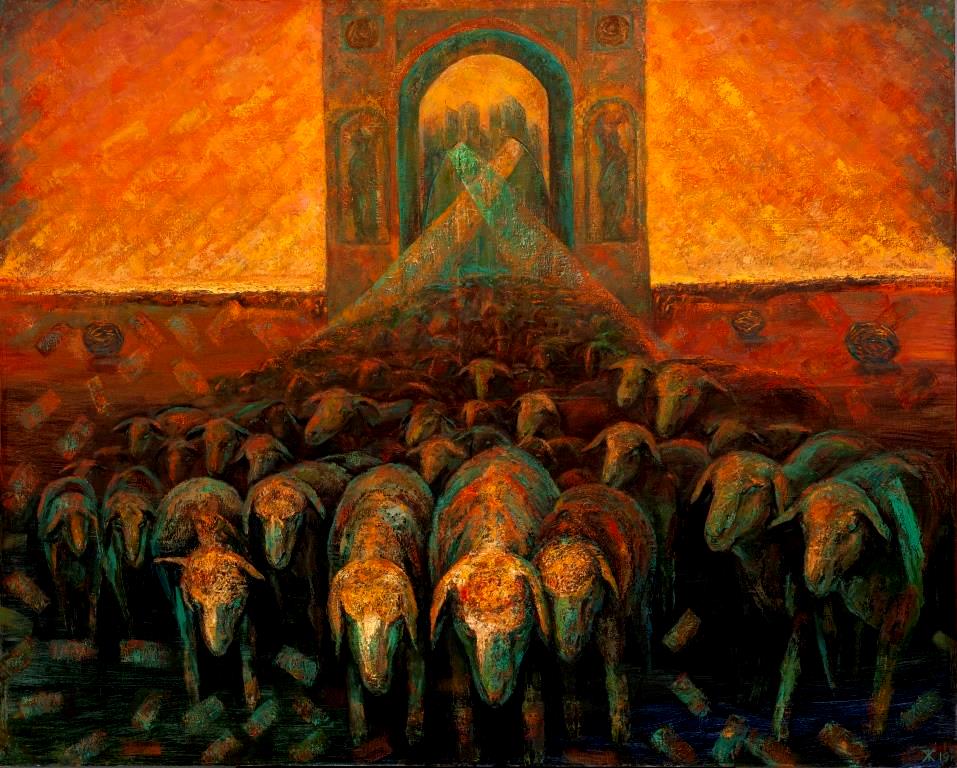
The work is an expressionistically rendered visual metaphor for collective movement.Compositionally, the work is dominated by the frontal movement of the flock, which draws the viewer into the pictorial space and actualises the motif of transcending the boundary between the depicted and the perceiver. In the background, a monumental arch, interpreted as an entrance to a sacred space, introduces the semantics of transition and threshold, reinforced by the radiant structure of light as an index of the ‘other’ or of a transcendent space.Symbolically, the sheep in this system of signs act as a collective subject, associated with a people in a state of movement, search or trial. The title ‘Qanbak’ (tumbleweed) reinforces the motif of existential instability.The colour scheme of the painting is based on the contrast between a warm, fiery, saturated background and the cool emerald-turquoise tones used to render the animal figures.