
Apple, 2024. Bronze. Almaty
Toktarbek Rakhyev
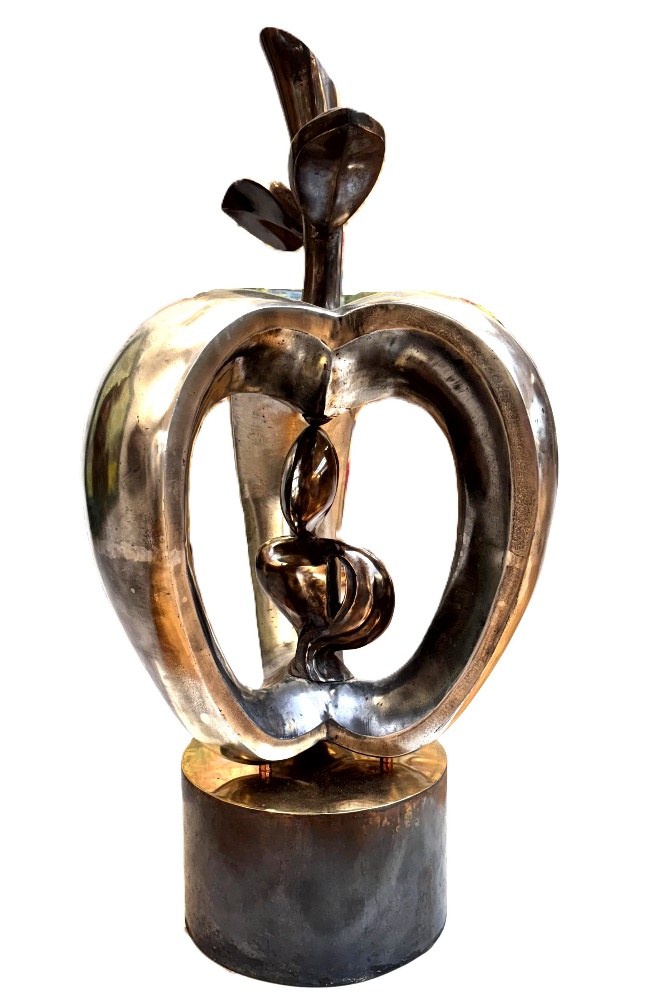
The natural image of the apple in the work is transformed into a symbolic spatial structure, where the recognisable form loses its object-like self-containment and becomes a sculptural framework. The outer contour retains an association with the fruit thanks to its soft, rounded lines, yet the main focus is on the inner space of the composition.The central element, reminiscent of a seed or embryo, organises the internal structure and shifts the image from the realm of natural representation into the realm of metaphor. The vertical axis of the stem and leaf sets the compositional axis, uniting all parts of the form and reinforcing the sense of growth and hidden internal movement.The bronze surface is constructed from a combination of polished and matt areas. Light, interacting with the smooth planes, makes the volume appear visually dynamic, whilst the recesses capture the shadow and emphasise the object’s spatial depth.The work takes on particular significance in the context of Almaty, where the image of the apple is linked to the city’s cultural and historical identity. At the same time, the artist avoids direct symbolic illustration, transforming the local motif into a universal symbol of the birth, renewal and continuity of life.The revealed form allows one to see the hidden inner content of the object, thanks to which the natural image takes on a philosophical resonance and is perceived as a metaphor for the life cycle and the potential for development.