
Monument to Abilkhan Kasteev. Almaty, in front of the A. Kasteev State Museum of Art of the Republic of Kazakhstan. Bronze, granite
Nurlan Dalbay
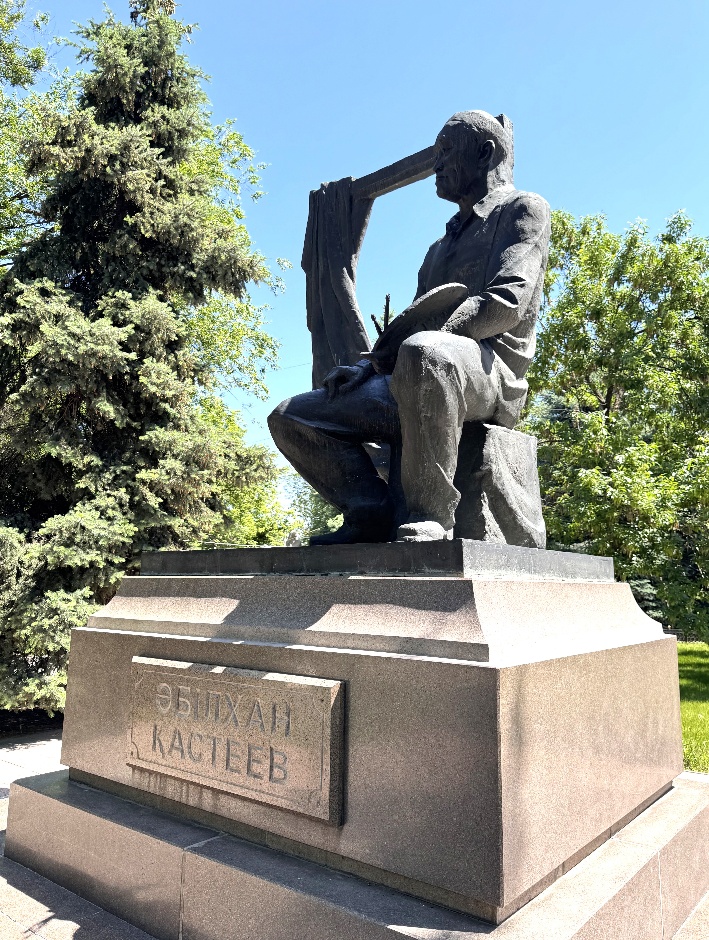
The monument to Abilkhan Kasteev is executed in an intimate and psychologically restrained style, which distinguishes it from traditional ceremonial monuments. The artist eschews external heroisation, focusing instead on the artist’s inner state and the creative process itself.The composition is built around a seated figure immersed in his work. The slight tilt of the torso and the turn of the head create a sense of concentrated thought and inner movement. The palette and brush are rendered in a generalised manner and do not overload the image with details, allowing them to be perceived rather as symbols of the creative act.A special role is played by the vertical element behind the figure, reminiscent of a frame or an easel. It organises the space of the composition and simultaneously introduces a symbolic boundary between reality and the artistic world. This motif becomes a kind of ‘frame of vision’ through which the artist interprets the surrounding space.The bronze’s plasticity is characterised by soft modelling and a restrained texture. The absence of decorative excess enhances the psychological expressiveness of the image, emphasising the figure’s pensiveness, inner composure and intellectual focus.The granite plinth maintains a sense of conciseness and stability, emphasising the monument’s connection to cultural memory. The placement of the sculpture in front of the Kasteev Art Museum reinforces its symbolic significance: the monument becomes a unique transition between the urban space and the world of art.Nurlan Dalbay’s work demonstrates a contemporary understanding of monumental sculpture, where expressiveness is achieved not through large-scale declarativeness, but through psychological depth and a finely constructed system of visual associations.