
‘Standard’ statuette, silver, gilded, lapis lazuli, carnelian, zircon, serpentine; filigree, openwork, casting, engraving. A. Kasteev National Museum of Arts of the Republic of Kazakhstan
Estay Daubaev
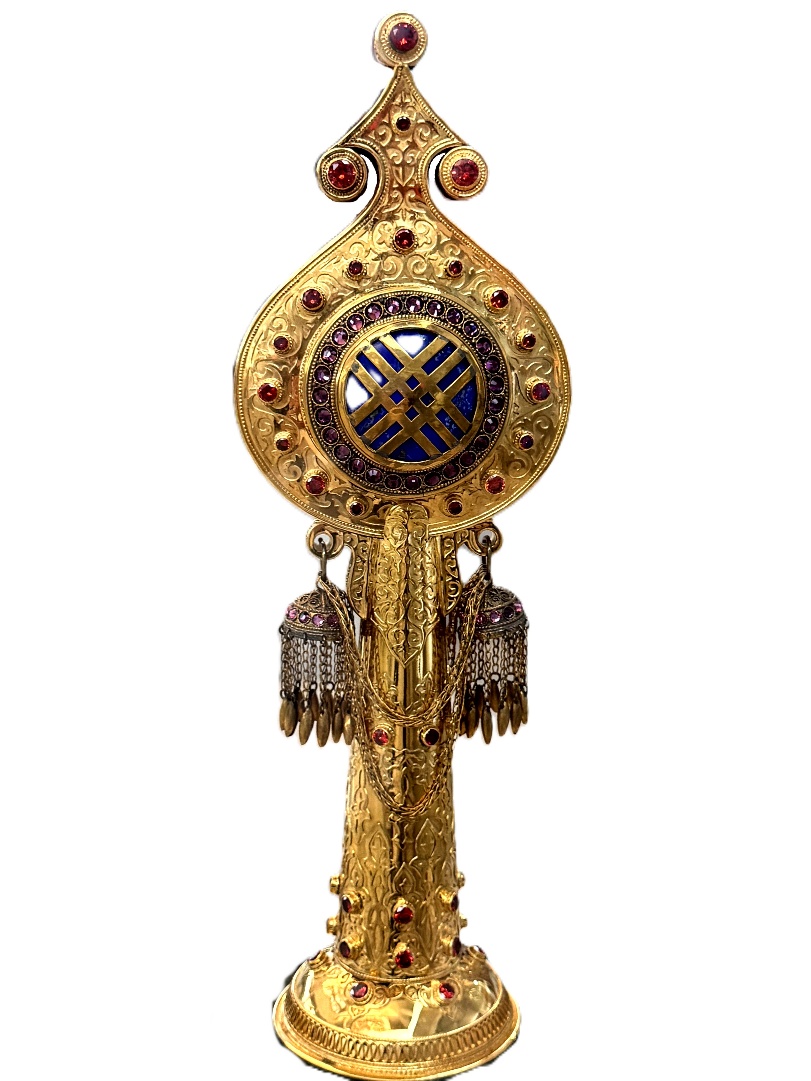
This vertically oriented object is crafted in the form of a stylised standard mounted on a stable base. The composition is centred around a massive column-like support and an elaborate upper section featuring a circular medallion, which serves as the principal visual focal point. The side hanging elements enhance the spatial expressiveness and lend the form additional decorative richness.The sculptural arrangement is based on the principle of axial symmetry and a hierarchy of elements. The central medallion, featuring a lapis lazuli inlay, is surrounded by an ornamental pattern complemented by carnelian and zircon. The surface of the object is richly decorated with filigree work: floral and geometric motifs form a complex decorative structure. The cylindrical base ensures compositional stability, whilst the gilding enhances the sense of unity and emphasises the solemn character of the work.The image of the standard is traditionally associated with ideas of power, collective identity and symbolic unity. The vertical form is perceived as an axis connecting various levels of sacred space, whilst the central medallion concentrates the main semantic meaning. The colour accents of lapis lazuli and carnelian reinforce associations with cosmological concepts, vital energy and spiritual strength.Using traditional techniques of filigree, inlay and gilding on a large scale, the artist creates a work that lies between decorative and applied art and sculpture. As a result, the object is perceived as a contemporary interpretation of a symbolic form, where the language of jewellery becomes a means of spatial artistic expression.