Traditional and contemporary art of Kazakhstan

A Virtual Journey into the World of Kazakhstan’s Artistic Heritage

This Web Gallery presents the diversity of artistic practices in Kazakhstan, reflecting the continuity of cultural traditions and the dynamic development of contemporary creative processes. The virtual exhibition features works based on national images, symbols, and themes, as well as artworks by contemporary artists who reinterpret the country’s cultural heritage through contemporary artistic forms, expressive means, and modern technologies.

The selected works demonstrate the relationship between traditional and contemporary art, revealing the distinctive features of the national worldview, cultural identity, and cultural meanings. The presented materials allow viewers to trace how elements of historical and cultural heritage are reflected in contemporary artistic practice, while maintaining their significance and relevance in an increasingly globalized world.

The Web Gallery is aimed at promoting Kazakhstan’s artistic heritage, expanding public access to works of art, and fostering a lasting interest in national culture and art among a wide audience.

Tekemet, 1960. N. Moldabayeva

Turkestan Region. • Tekemet, 1960. Felt, felting. • From the collection of the A. Kasteev National Museum of Arts of the Republic of Kazakhstan • (48-b).
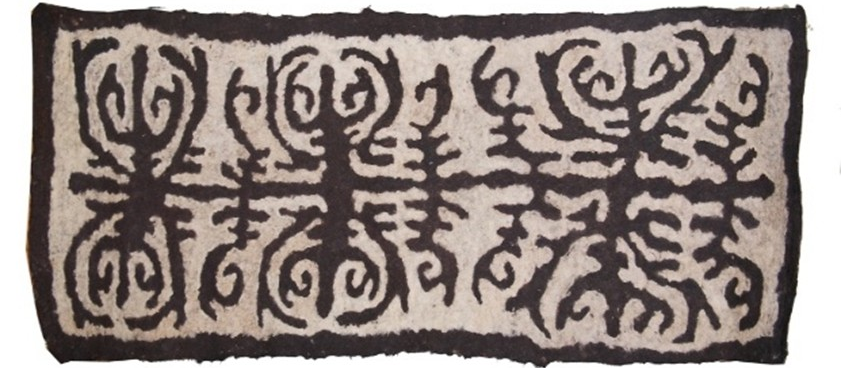
The tekemet on display features a bold and expressive design based on the contrast between black and white. The composition is structured according to the principle of symmetry and division into a central field and a surrounding border: the inner part is filled with large ornamental elements arranged in a rhythmically repeating row, whilst the dark border frames the composition and reinforces its self-contained nature. The ornament is very interesting and resembles anthropomorphic figures. The ornament’s plasticity is characterised by the enlargement of forms. The restrained colour scheme—a combination of black and white—enhances the symbolic resonance of the piece, drawing attention to the form and rhythm of the pattern.