
Craftsman’s residential house. 17th–18th centuries
Craftsman’s dwelling • 17th–18th centuries. Kultobe settlement, Turkestan Region
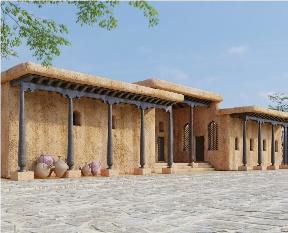
This residential building is of considerable interest as a monument to urban culture and traditional housing construction in late medieval Kazakhstan. The architecture of such houses reflects the characteristics of the daily life of the artisan population, which was closely linked to productive activities and the way of life in an Eastern city. The layout of the dwelling is characterised by its rationality and functionality. The house typically comprised living quarters, utility areas and a workshop, arranged around an inner courtyard. This spatial organisation provided insulation from the outside environment and created comfortable conditions for family and professional life. The inner courtyard served as an important compositional centre around which the family’s daily activities were organised.The hearth or tandyr occupied a central position, serving not only as a source of heat but also as the sacred centre of the dwelling. Niches in the walls were used for storing utensils and simultaneously formed a rhythmic structure within the interior space. The simplicity of the architectural forms was combined with a well-thought-out organisation of daily life and the aesthetics of the everyday.