Traditional and contemporary art of Kazakhstan

A Virtual Journey into the World of Kazakhstan’s Artistic Heritage

This Web Gallery presents the diversity of artistic practices in Kazakhstan, reflecting the continuity of cultural traditions and the dynamic development of contemporary creative processes. The virtual exhibition features works based on national images, symbols, and themes, as well as artworks by contemporary artists who reinterpret the country’s cultural heritage through contemporary artistic forms, expressive means, and modern technologies.

The selected works demonstrate the relationship between traditional and contemporary art, revealing the distinctive features of the national worldview, cultural identity, and cultural meanings. The presented materials allow viewers to trace how elements of historical and cultural heritage are reflected in contemporary artistic practice, while maintaining their significance and relevance in an increasingly globalized world.

The Web Gallery is aimed at promoting Kazakhstan’s artistic heritage, expanding public access to works of art, and fostering a lasting interest in national culture and art among a wide audience.

Carpet with ornament Samauyrgul 20th c.

2nd half of the 20th century. Kyzylorda Region. Wool yarn, pile weaving. KP 27002 (Catalogue, 91)
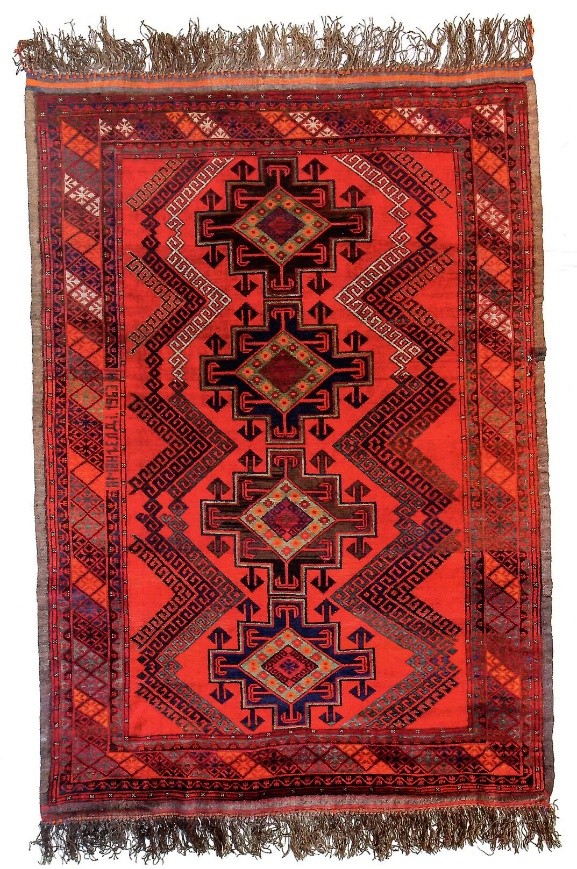
The carpet shown here is decorated with four large samayurgul rosettes, which are arranged in a horizontal composition, with each occupying approximately equal space. According to M.S. Mukanov (Mukanov, 1979), craftswomen began to name this rosette from the word ‘samayur’ – a traditional samovar – and ‘gul’ – flower, which reflects the shape and visual perception of the pattern. However, recent field research has revealed that craftswomen in Kyzylorda traditionally refer to this rosette as ‘kokmoiyn’. The etymology of this term remains unclear. It can be said with certainty that the meandering figures framing these rosettes are found on a number of ceramic vessels from the Andronovo period.