
Pileless carpet, 1950
1950s. Aktobe Region. Collection of the A. Kasteev State Museum of the Republic of Kazakhstan.
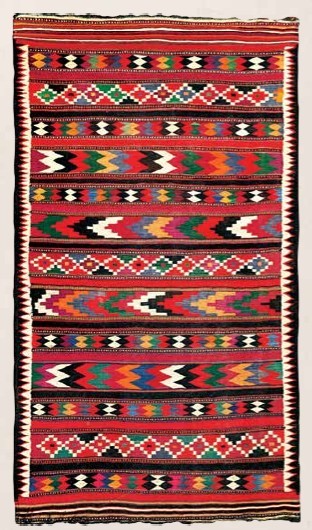
This example of a pile-less carpet is striking for the expressiveness of its artistic design — a bold combination of vivid colour contrasts and varied geometric shapes, arranged vertically. The clear, rhythmic organisation of the ornament creates a sense of movement, yet at the same time conveys the composition’s unity and inner harmony.The ornamental field combines the alabas motif (‘variegated peak’), single and paired rhombuses, triangles, and stripes of varying widths. The vertical orientation of the composition emphasises the carpet’s axial structure.Semantically, the alabas motif can be interpreted as an image of the world axis or the axis of life. Diamonds are traditionally associated with the idea of fertility and the earthly principle, whilst their paired arrangement reinforces the motif of duality — masculine and feminine, earthly and heavenly. The stripes form the spatial structure of the ornament, setting the rhythm.